|
|

TODAY.AZ / Politics
Russian analyst: Continued occupation of Azerbaijan's lands is inadmissible
26 January 2010 [16:05] - TODAY.AZ
Day.Az interview with Alexander Skakov, senior research fellow at Caucasus and Central Asia Department of the Russian Institute of Oriental Studies.
 How can you explain Turkey’s stepping up efforts to establish peace and stability in the region?
Turkey has stepped up its policy in the region after the August 2008. The Platform of Peace and Stability in the Caucasus that Ankara proposed earlier testifies to this. This initiative seems to be serious enough, even though today it has only a working nature. More likely, it will be remembered more than once and re-emerge and eventually may be realized.
In the meantime, Ankara has constantly indicated both in words and in action that it intends to share the role of leading power in the region with Russia. Turkey, like Russia, needs neither the U.S. nor the EU in the region. Turkey in every possible way emphasizes that it is ready to fully reckon with Russia’s interests. This is true about Abkhazia (one should not forget about large and influential Abkhaz Diaspora in Turkey), South Ossetia and Armenia. I think that Moscow and Ankara will continue to find common ground.
Unresolved Armenian-Turkish relations prevents Turkey from confirming its role of a leading power in the South Caucasus region. Therefore, Turkey agreed to sign the protocols, hoping to strengthen its political and economic influence in Armenia in future. Of course, the Armenian market is small, but they should not neglect it.
It should be noted that the Armenian-Turkish normalization not only opens up new prospects for Russia, but also poses new challenges for Moscow. For example, after this settlement, presence of Russia's military bases in Armenia will make no sense. However, I think that a mutual desire will enable to find forms to maintain this base. Further, Russia will face a serious and experienced competitor like Turkey in the Armenian economy. I think, however, that all this should not frighten us.
In your opinion, what is Russia’s true position on the Nagorno-Karabakh conflict? Under what scenario does Moscow want to resolve it?
In fact, the Nagorno-Karabakh conflict does not constitute foreign policy priorities of Russia This is not Abkhazia and South Ossetia. Nevertheless, after the events of August 2008, Russia has intensified its mediation mission not so much in the format of the Minsk Group (Russia's role there often seems somewhat inert), but on its own.
Suffice it to recall Main Dorf Declaration signed on Nov. 2, 2008. Moscow clearly realized that it should prevent a new armed conflict between Armenia and Azerbaijan as its consequences can be unpredictable also for the Russian interests in the region. In addition, if Russia does not play a mediating role, others will do it in their own interests. In the meantime, our main partners, in fact, have agreed that Russia plays the leading role in the settlement process.
What else Russia is interested in? I think that is important for Russia that transport communications between East and West in the South Caucasus will go not through Georgia, but through Armenia and Azerbaijan. Relations between Russia and Georgia have spoiled for long time. This can be said neither about Azerbaijan nor about Armenia.
As for the future of Nagorno-Karabakh, I think, Moscow (not only Moscow) understands that this question has two sides that would be better to address somewhat independently of each other. The first is a need to liberate the occupied regions around Nagorno-Karabakh (the problem of Lachin and Kalbajar arises in this regard). Continued occupation of these areas is unacceptable, it does not meet today’s standards. This situation must be addressed. The second is future of the so-called "NKR". We must find ways to solve the problem. It is important that both parties, I mean the Baku and Yerevan, were willing to compromise.
Can we say that the relations between Baku and Moscow have become much closer in recent years while relations between Yerevan and Moscow have cooled?
No doubt, the relations between Russia and Azerbaijan have significantly changed for the last 7-8 years. Azerbaijan and Russia share very much in common, we have a common sea, a common border and a common history. Azerbaijan holds quite right policies, diversifying its economic and political ties, forging relationships with everyone with whom they can establish it. The country's leadership has a great merit in this. Here is the difference between Armenia and Azerbaijan.
I do not think that Russian-Armenian relations have deteriorated in recent years. Just unlike Azerbaijan, Armenia does not have the required degree of consolidation of society around the authorities. The opposition which questions the legitimacy of power is much stronger. Accordingly, the power is less capable of some extraordinary, strong and breakthrough ideas and moves. The events surrounding the Armenian-Turkish protocols have showed that the situation in Armenia seems to be beginning to change. The power becomes stronger, it enjoys more support now and the opposition forces are losing influence. In any case, it is more easy to conclude contracts and to resolve issues with a strong authority.
There is another factor that hampers development of Russia-Armenian relations - lack of common border.
We try to assure our partners in Armenia that good relations between Russia and Azerbaijan are in Yerevan’s interests. The same can be said to you: good relations between Russia and Armenia in the interests of Azerbaijan. If we are closer to each other, controversial issues will be easier to solve.
H. Hamidov
URL: http://www.today.az/news/politics/60220.html
 Print version
Views: 3321
Connect with us. Get latest news and updates.
See Also
- 30 June 2026 [14:23]
Azerbaijan, Armenia launch anonymous reporting drive on missing persons - 30 June 2026 [14:14]
To revive the "dead man" - who and how in Armenia is holding on to the separatist project - 30 June 2026 [13:58]
Azerbaijan, Kazakhstan reaffirm strategic cooperation - 29 June 2026 [12:00]
And Burkina Faso slammed the door: the collapse of French politics in Africa - 29 June 2026 [11:51]
President Ilham Aliyev addresses participants of the Turkic World Week dedicated to the 100th anniversary of the First Turkological Congress - 29 June 2026 [08:30]
Why US-Iran confrontation persist despite diplomacy - 28 June 2026 [18:00]
Karabakh's education network continues to grow under Great Return State Program - 28 June 2026 [15:10]
Caucasus Eagle 2026 exercise successfully concludes [VIDEO] - 28 June 2026 [14:24]
Azerbaijani Parliamentary delegation to visit Ukraine - 28 June 2026 [13:30]
Azerbaijan, Kazakhstan strengthen logistics cooperation with electronic permit exchange
Most Popular
 Master's admissions continue to show strong growth as more students pursue higher degrees
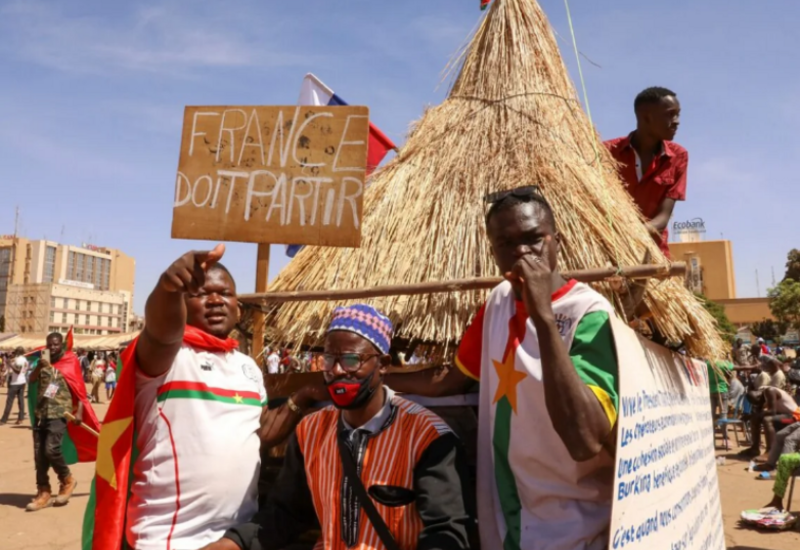 And Burkina Faso slammed the door: the collapse of French politics in Africa
 Azerbaijan Army enhances officer training with specialized demonstration classes
 To revive the "dead man" - who and how in Armenia is holding on to the separatist project
 Ukraine seeks French license to produce SCALP cruise missiles
 First Round of 16 team confirmed at FIFA World Cup 2026
 Azerbaijan, Kazakhstan strengthen logistics cooperation with electronic permit exchange