|
|

TODAY.AZ / Politics
Will the EU replace the Russian market for Armenia?
03 June 2026 [13:13] - TODAY.AZ

Since June 2, Russia has refused to allow Armenia to import
another type of goods - fruits with pits. Namely: grapes, apricots, cherries,
cherries, plums, peaches and nectarines.
Since the same day, according to the Rosselkhoznadzor's
decision, restrictions have been imposed on the supply of live fish and fish
products from Armenia. Only two manufacturers received permission, and
inspections were carried out at their enterprises at the end of May.
These decisions are a continuation of the measures taken by
Russia regarding Armenian imports in connection with Yerevan's statements about
the European choice. Of course, the Rosselkhoznadzor's steps are not motivated
politically, but are explained by the presence of quarantine facilities in
Armenian products that are prohibited in the EAEU space. However, the political
motivation of the steps taken towards Yerevan in the run-up to the elections
leaves no doubt in anyone's mind.
It seems that Moscow has only recently learned about
Armenia's pro-European intentions, although Yerevan has been talking about this
for a long time. In May, Russia abruptly began to impose restrictions on the
products of Armenian manufacturers. Since May 22, the import of flowers from
Armenia to Russia has been restricted, as well as the supply and sale of
imported batches of Jermuk mineral water. Since May 23, the sale of alcoholic
beverages from several leading Armenian companies in Russia has been banned,
and since May 30, the import of tomatoes, cucumbers, greens and strawberries
from Armenia has been banned. In all cases, the ban was explained by a
violation of phytosanitary standards and safety requirements.
Armenian Prime Minister Nikol Pashinyan commented on the
restrictions imposed by the Russian side. He stated that he considers these
steps to be wrong and inciting Armenian citizens against the EAEU. For him, as
prime minister, all this is a problem. "But we will solve all these
problems," Pashinyan said.
The Armenian prime minister promised to support local
companies affected by the restrictions imposed by Russia. He said this during a
meeting with residents of the village of Lchashen, Gegharkunik region.
"The government has already decided that in all cases where unfair
obstacles to exports arise, we will implement support programs, we will
implement programs to subsidize these goods so that there will be no casualties
in our economy," he said at a meeting with voters. Pashinyan also promised
to find new markets for Armenian farmers. According to him, several business
delegations have left for negotiations and there are already concrete proposals
for the purchase of roses, fruits and vegetables.
European countries also expressed their support for Armenia
in the current situation. According to European media, European Commission
representative Anouar El-Anouni stated that "we are a reliable partner for
Armenia, and our partnership is stronger than ever."
Armenia does not hide that it counts on the support of its
European partners. If the European course has put the country in front of such
problems, it is the European Union that should help the republic get out of
them.
Armenian Economy Minister Gevorg Papoyan announced that the
Armenian government is launching a program to support agricultural exporters to
enter the European Union market. According to him, Armenian products meet
European requirements, and high logistical costs remain the only obstacle.
Nevertheless, the Government of Armenia is optimistic. Papoyan stated that
Armenia's export fruits and vegetables have a Global G.A.P certificate (an
international standard confirming the environmental friendliness, safety and
high quality of agricultural products), meaning Armenian apricots and tomatoes
can be sold in European supermarkets.
As a way out, the government has developed a compensation
program for manufacturers. Papoyan said that compensation, for example, for
flower exporters by the end of the year will amount to about $ 5.5 million, for
tomato and pepper producers - $ 3.5 million each.
But at the same time, logistics issues remain. Armenia ran into the consequences of the long-term conflict with Azerbaijan when it did not expect it. The moment has come when Armenia's thirty-year isolation has become a real obstacle to solving a problem of strategic importance. Europe, against the background of Yerevan's loud "divorce" from Moscow, can to some extent support the country aspiring to its embrace. But what to do if there are no well-established logistics routes?
Armenian exports to Europe have never been large-scale.
Traditionally, it is carried out through Georgia, as the border with Turkey is
closed. Goods are transported by road or rail to the Black Sea ports of
Georgia, and from there they are ferried to Europe. Or they move overland
through Turkey. Due to the opening of the Akhalkalaki-Kars railway line, which
is part of the Baku-Tbilisi-Kars corridor, Armenia has the opportunity to use
this logistical route, as it was already announced recently.
Since logistics for Armenian products will not be cheap, its
price competitiveness in the European market will be lower than local goods. It
is impossible to solve the logistics problem quickly. Armenia has always been
focused mainly on the European and post-Soviet markets. The preferences
provided to it as a member of the Eurasian Economic Union have so far allowed
it to make a profit without serious costs and losses. Yerevan understands this.
It is no coincidence that Nikol Pashinyan stated that Armenia will remain in
the EAEU as long as it does not contradict the reforms carried out within the
framework of the country's European integration.
But Moscow is not going to wait for this moment. They
believe that the very formulation of the issue contradicts the interests and
rules of the EAEU. The restrictive measures taken against Armenia are not
caused by the presence of fruit flies or California scabies in vegetables and
fruits from Armenia. They are caused by Yerevan's plans that violate the traditional
Russian monopoly on this South Caucasian country.
Anyway, the loss of the Russian market and the market of
other EAEU countries, of course, will be a serious blow to the Armenian
economy. It will be very difficult for Armenia to make up for this loss quickly
and at the same level. Its economy has been oriented in only one direction for
a very long time. Reorienting the economy is much more difficult than making
political decisions.
Why the Russian side decided to vent its discontent right
now hardly requires explanation. In the run-up to the elections, Russia wants
to show the Armenian society what a change of course threatens it with. But
will all this have the expected effect? It may turn out that tightening the
"noose", on the contrary, will play in favor of the current
government and reduce the ranks of opponents of integration with the EU. There
are not many of the latter in Armenia as it is.
P.S. The Rosselkhoznadzor has restricted the import of
sunflower seeds, eggplants, potatoes and dried fruits from Armenia since June
3. We can say that Russia has completely abandoned Armenian imports.
URL: http://www.today.az/news/politics/268181.html
 Print version
Connect with us. Get latest news and updates.
See Also
- 08 July 2026 [11:08]
President Ilham Aliyev receives Deputy Prime Minister of Jordan - 07 July 2026 [14:14]
Azerbaijan as crossroads of roads and interests - 07 July 2026 [11:22]
President Ilham Aliyev receives member of U.S. Senate Foreign Relations Committee - 06 July 2026 [15:43]
Azerbaijan facilitates new 1,026-ton propane transit to Armenia - 06 July 2026 [15:15]
Mandate is more expensive than principles: Kocharyan abruptly changed his mind - 06 July 2026 [13:25]
President Ilham Aliyev sends congratulatory letter to President of Malawi - 06 July 2026 [12:12]
Fakes and mathematics - where do Armenian myths come from? - 03 July 2026 [14:50]
US economist Jeffrey Sachs visits Baku, holds talks with Hikmet Hajiyev - 03 July 2026 [12:27]
President Ilham Aliyev sends congratulatory letter to President of Belarus - 03 July 2026 [12:12]
EU recognizes unique role of Azerbaijan
Most Popular
 Armenian PM Nikol Pashinyan arrives in Russia for Innoprom 2026
 Zelensky rejects Russian claim of capturing Kostyantynivka, warns of new offensive
 Israeli analyst calls Armenian Genocide recognition plan a 'childish mistake'
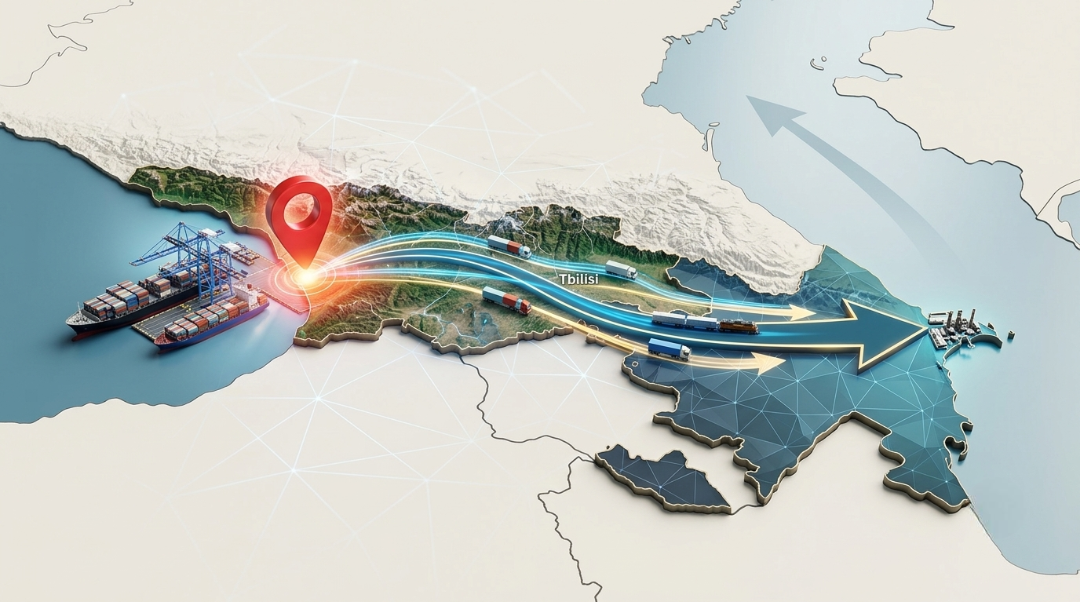 Georgia's Anaklia shift opens door to new investment and stronger Middle Corridor
 Israel's Katz clarifies ‘Death to Trump’ chants not considered constructive diplomatic language
 U.S. Secretary of Defense Pete Hegseth to hold high-level talks in Israel amid F-35 concerns
 Azerbaijan as crossroads of roads and interests