|
|

TODAY.AZ / World news
UN to evaluate refugee strategy
13 December 2025 [19:15] - TODAY.AZ
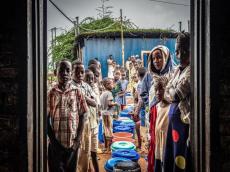
The United Nations will appraise its policies on refugees next week, due to an increase in armed conflict, the politicization of asylum law and cuts to international aid, Azernews reports, citing Arab News.
Governments, civil society, the private sector and academics will jointly assess progress over the last few years and put forward new solutions at a Global Refugee Forum Review meeting from Monday to Wednesday.
Donor commitments are also expected, with the UN refugee agency facing a massive crisis.
The number of people forcibly displaced worldwide has almost doubled in the last decade to 117.3 million but funding for international aid has slumped, not least after the return of Donald Trump to the White House.
The United States previously provided more than 40 percent of the UNHCR budget but cuts by Washington since January, combined with belt-tightening from other major donor countries, have forced the organization to shed nearly 5,000 jobs — more than a quarter of its workforce.
“Now is not the moment to step back — it is the moment to reinforce partnerships and send a clear message to refugees and host countries: you are not alone,” said UNHCR’s chief of the global compact on refugees section, Nicolas Brass.
The number of people forced to flee persecution, conflict, violence, human rights violations and serious unrest increased in 2024 to a record 123.2 million refugees, internally displaced and asylum-seekers.
At the end of last year, just over a third were from Sudan (14.3 million), Syria (13.5 million), Afghanistan (10.3 million) or Ukraine (8.8 million).
“Across countries and communities, support for refugees continues,” said Brass, adding that two-thirds of the pledges made at the last Global Refugee Forum were “fulfilled or in progress.”
- ‘Serious risk’ -
According to the UNHCR, 10 countries have adopted new labor laws authorizing refugees to work since 2019, which has helped more than 500,000 people.
Ten countries have strengthened their asylum system, including Chad, which adopted its very first asylum law.
But in a recent report, UNHCR chief Filippo Grandi said the “sharp decline” in funding this year and that “available solutions fall far short of global needs.”
“Hard-won improvements are at serious risk,” he added. “Without renewed political will, sustained financing and coherent multilateral cooperation, these pressures threaten to erode the very systems we have worked tirelessly to build.”
Grandi is due to step down after 10 years at the helm and is expected to be succeeded by Iraq’s former president Barham Salih.
“The global context is deteriorating amid continued conflict, record civilian deaths... and deepening political divides, which are driving displacement and straining the system,” said Brass.
The UNHCR said burden-sharing remained unequal. Countries with only 27 percent of global wealth are hosting 80 percent of the world’s refugees.
The agency recently highlighted that three-quarters of displaced people live in countries at high or even extreme risk from climate change.
From Monday, discussions among the 1,800 delegates and 200 refugees will center around five themes: innovative financing; inclusion; safe pathways to third countries; transforming refugee camps into “humane settlements“; and long-term solutions.
Parallel events dedicated to major displacement situations will also be held, notably on Syria, Sudan and the Rohingya refugee crisis.
URL: http://www.today.az/news/regions/264089.html
 Print version
Connect with us. Get latest news and updates.
See Also
- 01 October 2026 [11:48]
Latvia ready to host nuclear weapons under NATO decision, president says - 01 October 2026 [11:01]
Netanyahu claims Israeli intelligence warned UK of suspected Iran-linked attack - 01 October 2026 [10:29]
Pentagon announces new autonomous warfare command to accelerate drone development - 01 October 2026 [10:00]
Three earthquakes strike Russia - 01 October 2026 [09:00]
AliExpress plans to test new VIP program - 30 September 2026 [14:00]
Russia’s hybrid war is raising fears of a ‘dark winter’ across Europe - 30 September 2026 [13:45]
US officially concludes 'Inherent Resolve' mission in Iraq - 30 September 2026 [12:33]
Pekin warns EU of firm response as trade tensions escalate - 30 September 2026 [12:04]
Russia warns of nuclear response if Kaliningrad is isolated - 30 September 2026 [11:54]
Trump draws distinction between North Korea and Iran over nuclear weapons
Most Popular
 UK updates sanctions licence for Azerbaijan's Shah Deniz project
 Russia’s hybrid war is raising fears of a ‘dark winter’ across Europe
 Armenian historians have acknowledged defeat on Albanian issue
 Trump draws distinction between North Korea and Iran over nuclear weapons
 Russia warns of nuclear response if Kaliningrad is isolated
 Poland temporarily closes airports due to Russian strikes
 Czech CSG plans to manufacture self-propelled howitzers in Azerbaijan from 2027