|
|

TODAY.AZ / Politics
Armenia finally takes up the TRIPP project - the opposition is panicking again
19 January 2026 [10:10] - TODAY.AZ

Armenia finally takes up the TRIPP project - the opposition
is panicking again
"I do not envy the conspirators and those who predict
the destruction of our society day and night. Have a nice day." Armenian
Foreign Minister Ararat Mirzoyan concluded his social media post with these
words. The post was dedicated to a joint statement by Armenia and the United
States regarding the framework for the implementation of the TRIPP project. The
Foreign Minister advised the Armenians to read this document, which is useful
for Armenia.
After the statement was published, opponents of the current government
hastened to cast doubt on the fragile minds, convincing them that TRIPP is
dangerous for Armenia's sovereignty, and it is useful only for Azerbaijan,
which pursues its own interests.
Of course, Azerbaijan pursues its own interests. Moreover,
he ensured that his national interests were accepted as the interests of all
project participants. And most importantly, these interests do not contradict,
but just completely coincide with the interests of Armenia. It's just that
before the United States joined the case, Yerevan was afraid to admit it,
fearing the reaction of the local opposition camp. Buckets of dirt are still
falling out on Nikol Pashinyan, but the presence of a country like the United
States in the foreground makes opponents slow down somewhat. Today, criticism
of TRIPP is developing with an emphasis not on the interests of Azerbaijan, but
on "what will Iran say?" The revanchists are doing the same thing
that the official authorities used to do - they are holding on to the Iranian
position on the Zangezur corridor. Previously, the revanchists held on to the
opinion of Russia, which does not seem to mind, but always has a
"BUT". Iran's position is more beneficial to Pashinyan's opponents,
as it is unequivocally negative.
Official Tehran is not up to TRIPP right now, but the country's ambassador to Armenia sings like a nightingale almost every day. This is what the revanchist opposition has seized upon, for which every step taken by the Armenian authorities towards Azerbaijan serves as another nail in the lid of the opposition coffin. The fewer such nails there are, the better for the revanchists.
Opposition politicians and experts are wringing their hands
and scaring Armenians with the impending closure of the road of life - the
border with Iran. Armenia is closing its border with Iran for 100 years, Levon
Zurabyan, who is running to replace Pashinyan, announced on social media. Levon
Ter-Petrosyan's deputy considers the project to be the end of Armenian
sovereignty, a humiliating deal and a diplomatic failure. Zurabyan does not
like the conditions of unhindered communication between the main part of
Azerbaijan and Nakhchivan. This figure is unable to realize the simple truth -
the Armenian side does not have the right to a full-fledged inspection of
passengers and cargo traveling non-stop from Azerbaijan to Armenia. Cargo and
passengers that will be sent non-stop through the territory of Armenia, from
Baku or other regions of the Republic of Azerbaijan to the NAR, do not fall
under the category of international transportation. All Azerbaijan will owe its
neighbors is a transit fee. Of course, customs documents will need to be
processed in accordance with international and Armenian laws. There won't be
any problems here, and Zurabyan doesn't have to worry. After the launch of the
Zangezur corridor, other countries will be able to use it. Armenian customs
officers and border guards can inspect transit cargo and passengers of third
countries as much as they like. There are also no questions about trains
leaving Azerbaijan or transiting through Azerbaijan from third countries to
Armenia itself. This will be the full jurisdiction of the Armenian side.
It seems that under the same conditions, Armenia will be
able to use the Nakhchivan section of TRIPP if it needs to deliver goods and
passengers by rail from the western to the eastern part of the country.
Although there is a very important nuance here: the length of the Meghri
section is only 40 kilometers, and the Nakhchivan section is almost 190 kilometers.
However, with normal relations between neighboring countries and the existence
of bilateral agreements, all issues can be resolved.
Last week, representatives of Azerbaijan and Armenia jointly
inspected the condition of the railway infrastructure on the Sadarak-Yeraskh
section. The purpose of the inspection was to assess the technical suitability
of this section of the track for the movement of special railway construction
equipment. Within the framework of the TRIPP project, it is planned to restore
this road, which in Soviet times reached Yerevan. Yes, in Soviet times it was
possible to travel by train from Baku to Yerevan via Nakhchivan.
The Zangezur corridor, which is rejected by Iran, is fully
supported by Turkiye, which is also an irritating factor for the Armenian
opposition.
At a press conference in Istanbul on Friday, Turkish Foreign
Minister Hakan Fidan said that his country is interested in implementing the
Zangezur Corridor project in a format fully consistent with Azerbaijan's
position. He stressed that Turkey and Azerbaijan are considering the TRIPP
project in the context of the Zangezur Corridor. According to him, the TRIPP
document, adopted in Washington on January 13, was analyzed in detail by the
Turkish side and discussed for almost two hours with Azerbaijani Foreign
Minister Jeyhun Bayramov.
The Turkish Foreign Minister also expressed support for
Nikol Pashinyan's constructive role in the peace process and hinted at the
support of the prime minister from the Armenian public opinion.
The latter was terribly disliked by the Armenian opposition,
which saw in these words Pashinyan's pre-election PR, which means interference
in the internal affairs of Armenia. Speaker of the Armenian Parliament Alain
Simonyan denied the claims of revanchists that Fidan allegedly declared his
support for Nikol Pashinyan in the 2026 elections. "No such thing was
said," Simonyan told reporters. According to him, the Turkish minister
only noted the support for the process being implemented by the current Armenian
government. And he thanked Fidan for supporting "the call of the majority
of Armenian society for peace and the development of trade, including trade
within the framework of the TRIPP initiative."
After the terms of the deal on the road through Meghri were
made public, not only the Armenian opposition began to squirm. Long-time
Armenian lobbyist Konstantin Zatulin also decided to contribute his five
kopecks. The deputy chairman of the State Duma Committee on CIS Affairs said
that Pashinyan is trying to draw Russia into the "Trump route" only
to deflect criticism from himself, and not for the sake of Russia's interests.
"Armenia wants to turn the tables on Russia, it is not interested in
Moscow's interests," Zatulin told one of the Russian Telegram channels. At
the same time, the lobbyist compared the current situation with that of the
Russian peacekeepers, who "were first invited to Karabakh, and then
actually ignored their presence."
Due to his own mindset, Zatulin sees sophisticated and insidious anti-Russian plots everywhere. At the same time, the restoration of railways in Armenia is a direct obligation of Russia, which has been concessionary management of this infrastructure for decades. The Hrazdan-Dilijan-Ijevan-Gazakh road, as well as the railway section to the border with Turkiye, are an integral part of the Armenian railway network. This explains Nikol Pashinyan's appeal to Moscow, and not to Burkina Faso. The TRIPP project only provides for communication through Megri. The Americans are not going to expand to the entire territory of Armenia, they only need this strategic area. At least because the Middle Corridor can be built through Armenia only along this route. No conspiracy theory. Zatulin should not look for a black cat in a dark room. She's definitely not there.
By the way, Pashinyan pointed out that if Russia does not
have the opportunity to start rebuilding these roads as soon as possible,
Armenia will withdraw these sections from the concession management of the
Southern Railways and restore them itself.
It would be more reasonable for the Russian side to fulfill
its concession obligations rather than assume the position that Konstantin
Zatulin suggests.
Whether these roads will work before the signing of peace
and the appearance of the Zangezur Corridor or not is not Moscow's concern. The
railway crossing in Gazakh will not open until the crossing in Agband is
operational. And the transition to Agband is unlikely to work before peace is
signed and diplomatic relations are established. This is clear to everyone,
including the Armenian side. As political analyst Armen Baghdasaryan told
reporters, the TRIPP project is not part of the peace process, but reflects its
possible outcome. The project, he believes, will succeed only if, firstly,
peace between Armenia and Azerbaijan is institutionalized, and, secondly,
Armenian-Turkish relations are fully normalized. If this is not the case, the
project will not be implemented.
Well, don't be so gloomy. The corridor, most likely, will
not work until the signing of the peace. However, this does not mean that
Armenia should not start work on its territory. It will also benefit her if the
entire infrastructure is ready by the time the peace is signed. Azerbaijan is
already completing communications in Eastern Zangezur, and now modernization
and construction on the Nakhchivan railway are beginning. We need to look ahead
and see the future. If the Azerbaijani side invests money in this project, then
it will definitely be there. No matter who tried to interfere with him.
URL: http://www.today.az/news/politics/264906.html
 Print version
Connect with us. Get latest news and updates.
See Also
- 29 June 2026 [12:00]
And Burkina Faso slammed the door: the collapse of French politics in Africa - 29 June 2026 [11:51]
President Ilham Aliyev addresses participants of the Turkic World Week dedicated to the 100th anniversary of the First Turkological Congress - 29 June 2026 [08:30]
Why US-Iran confrontation persist despite diplomacy - 28 June 2026 [18:00]
Karabakh's education network continues to grow under Great Return State Program - 28 June 2026 [15:10]
Caucasus Eagle 2026 exercise successfully concludes [VIDEO] - 28 June 2026 [14:24]
Azerbaijani Parliamentary delegation to visit Ukraine - 28 June 2026 [13:30]
Azerbaijan, Kazakhstan strengthen logistics cooperation with electronic permit exchange - 28 June 2026 [08:30]
Turkic Investment Fund: sovereign shield against great power competition - 27 June 2026 [13:15]
Leyla Aliyeva and Arzu Aliyeva visit “CandyFest” summer festival in Baku - 27 June 2026 [12:10]
Leyla Aliyeva and Arzu Aliyeva participated in action for planting seasonal flowers on Baku Boulevard
Most Popular
 Master's admissions continue to show strong growth as more students pursue higher degrees
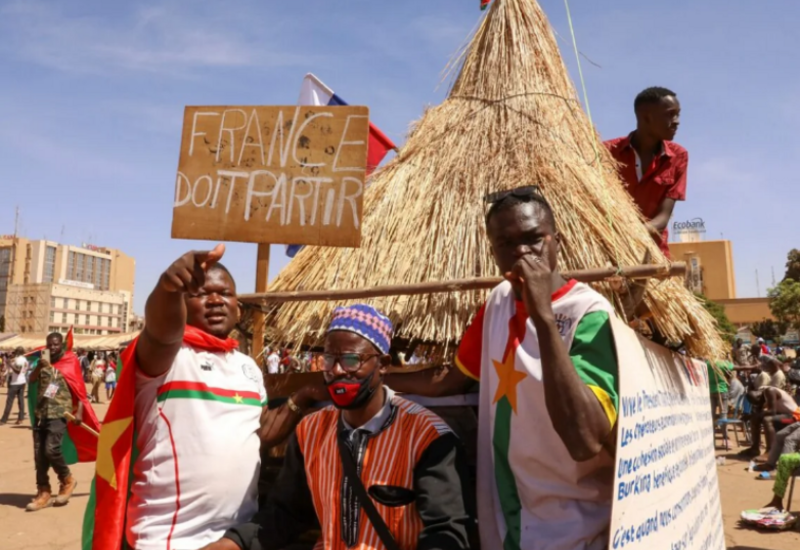 And Burkina Faso slammed the door: the collapse of French politics in Africa
 Azerbaijan Army enhances officer training with specialized demonstration classes
 Tanker attacked in Strait of Hormuz, UKMTO warns of floating mines
 Azerbaijan, Kazakhstan strengthen logistics cooperation with electronic permit exchange
 National Academy of Sciences expands partnership with Vatican Apostolic Library and Apostolic Archive
 Venezuela welcomes 1,600 foreign rescuers in urgent search for quake survivors