|
|

TODAY.AZ / Arts & Entertainment
Azerbaijan, Uzbekistan forge partnership for education and research
01 December 2025 [11:43] - TODAY.AZ
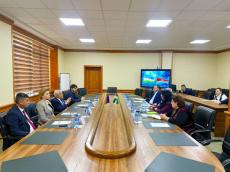
Baku Engineering University has signed a Memorandum of Understanding (MoU) with the Uzbekistan National University named after Mirzo Ulugbek, Azernews reports. The agreement was concluded as part of the QS Eurasia Forum 2025.
During the signing ceremony at Uzbekistan National University, the parties exchanged detailed views on the current activities of the two universities, recent achievements, and priority goals in scientific and academic fields. The meeting served as an effective platform to broadly discuss the prospects for bilateral cooperation.
Rectors Yaqub Piriyev and Inom Madjidov emphasized that the friendly relations between Uzbekistan and Azerbaijan are also developing at a high level in the fields of education and science.
During the meeting, several key issues were thoroughly discussed. These included organizing joint dual-degree programs and expanding academic mobility opportunities.
The parties also considered involving faculty members as supervisors for doctoral students. They also discussed increasing the number of joint scientific articles published in reputable journals indexed in Scopus. Finally, initiatives for sustainable scientific collaboration in engineering, chemistry, and economics were addressed.
The MoU will play a solid foundational role in implementing the planned projects in the future and advancing cooperation in scientific-technical and educational fields to a new level.
The QS Eurasia Forum 2025 was held in Tashkent, Uzbekistan at Central Asian University under the theme "Broadening Horizons: Building Global Bridges in Higher Education".
It gathered over 300 participants including university leaders, government officials, experts in education, and representatives of research institutions from Eurasia and beyond.
The agenda included plenary sessions, master?classes, and workshops on topics such as university internationalization, global academic partnerships, innovation, higher?education quality, and preparing for global rankings.
The event provided a platform for higher education institutions from different countries, including Azerbaijan, to engage in dialogue, explore collaboration, and strengthen academic and research cooperation across the Eurasian region.
URL: http://www.today.az/news/entertainment/263852.html
 Print version
Connect with us. Get latest news and updates.
See Also
- 25 September 2026 [15:42]
Katy Perry headlines tonight's Azerbaijan Grand Prix concert - 25 September 2026 [15:13]
Traditional music captivates audience in Baku - 25 September 2026 [13:28]
Nearly 50,000 apply to volunteer at Formula 1 Azerbaijan Grand Prix - 25 September 2026 [11:13]
ADA University hosts lecture-concert within 'Art Masterpieces' project - 25 September 2026 [10:47]
Baku hosts Living Culture Festival - 25 September 2026 [10:15]
Azerbaijan, Georgia seek to expand youth and sports cooperation - 23 September 2026 [13:48]
Icherisheher launches Community Center for residents - 23 September 2026 [13:25]
National dancer's clip wins prestigious award in Greece - 23 September 2026 [12:15]
Yeni Gala Concert Complex opens as part of Uzeyir Hajibayli Int'l Music Festival - 23 September 2026 [10:26]
Baku’s tenth race: what to expect from 2026 Azerbaijan Grand Prix
Most Popular
 Documents signed on sidelines of Second Azerbaijan International Investment Forum exchanged
 Azerbaijan Infrastructure Dialogue brings together global investors
 OpenAI AI agents targeted US government websites for data access
 Hybrid campaign targets Azerbaijan-Türkiye brotherly ties
 Marneuli hosts event honoring Azerbaijani martyrs
 President Ilham Aliyev attends inauguration ceremony for "Minkend" Small Hydroelectric Power Plant and "Textile Cluster" production facility
 Azerbaijan observes Remembrance Day across country