|
|

TODAY.AZ / Analytics
Azerbaijan advances digital trade governance with new digital logistics platform
17 December 2025 [08:30] - TODAY.AZ

In today’s world, it is difficult to imagine economic life without digitalization. Rapid technological progress has reshaped not only everyday services but also the way states regulate, monitor, and optimize economic processes. Digital solutions increase efficiency, reduce human-related risks, strengthen institutional oversight, and ultimately improve citizens’ welfare. As digitalization deepens, transparency grows, services become more accessible, and decision-making shifts from fragmented procedures to data-driven governance.
As part of this broader transformation, Azerbaijan’s recent steps toward the digital transformation of foreign trade and logistics represent a strategically important development. A new stage in this process was marked this week by a decree signed by President Ilham Aliyev on additional measures to digitalize import-export, transit, transport, and logistics activities.
From fragmentation to a unified digital ecosystem - According to the decree, a unified “Single Window” information system will be established to improve state regulation in foreign trade, ensure effective coordination among government institutions, and create a fully digital environment with single access to import, export, transit, transport, and logistics operations. The initiative also envisages the introduction of a “smart” cargo flow management system.
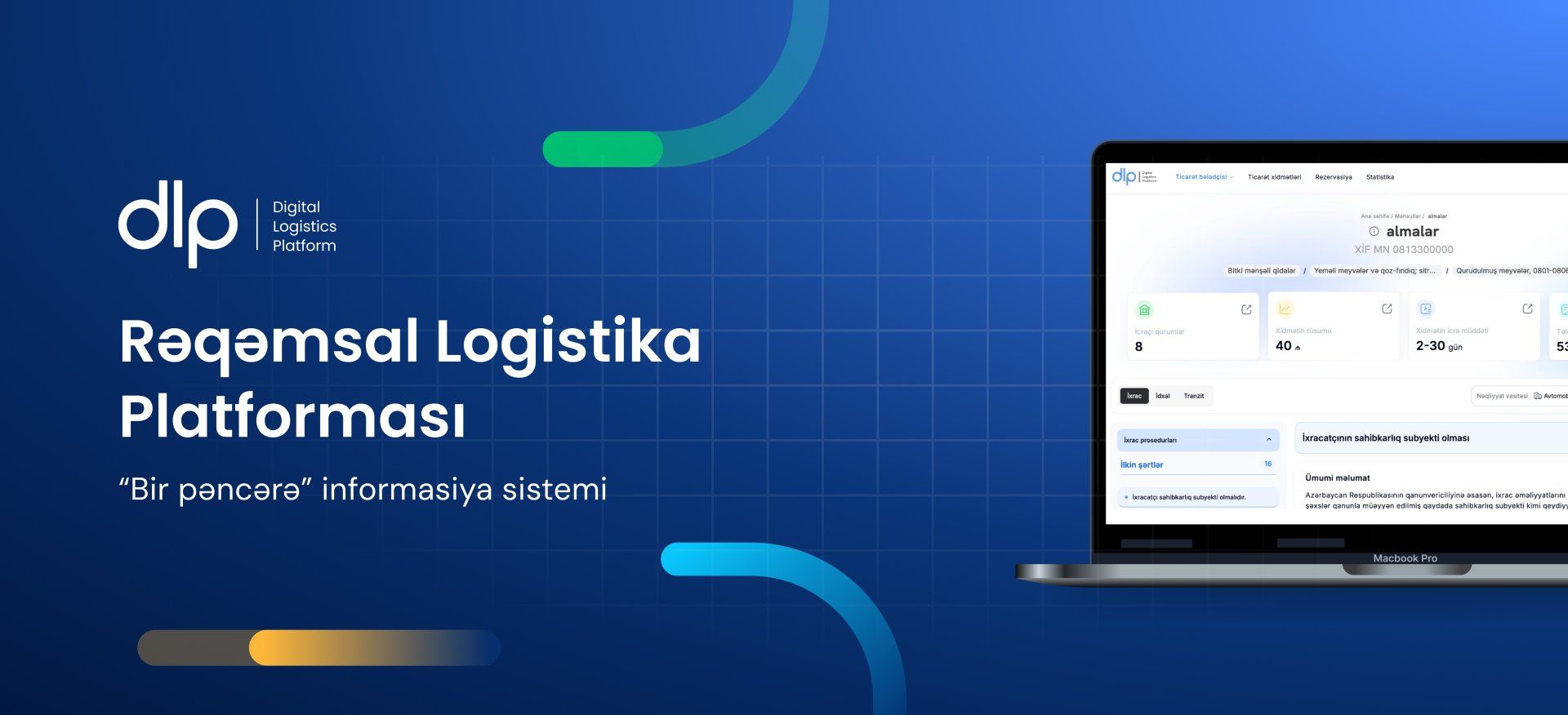
At the core of this transformation is the creation of a Digital Logistics Platform (DLP) by the Ministry of Digital Development and Transport, in cooperation with other relevant institutions. The platform aims to digitize international cargo transportation processes, enable real-time data exchange between foreign trade participants and state bodies, and significantly enhance Azerbaijan’s competitiveness in regional and global logistics chains.
Analytically, this move reflects a shift from document-based control to system-based governance. Instead of managing trade flows through isolated procedures and manual approvals, the state is building an integrated digital ecosystem where information flows seamlessly and decisions are supported by real-time data.
Why digital logistics platform matters
The DLP is designed as a unified “electronic single window” for managing import, export, and transit operations. Its strategic importance lies in three key dimensions:
1. Efficiency and cost reduction - Currently, foreign trade participants must apply separately to multiple institutions for permits and documents, often submitting the same information repeatedly. This results in delays, administrative burdens, and increased transaction costs. By consolidating these processes into a single digital platform, the DLP eliminates duplication, shortens processing times, and reduces operational costs for businesses.
2. Transparency and predictability - Digitalization minimizes discretionary decision-making and human-related risks. When procedures are standardized and tracked electronically, the likelihood of delays, informal practices, or inconsistencies decreases. For investors and logistics operators, predictability is as important as speed, and the DLP directly addresses this need.
3. Data-driven policy and control - The platform allows state institutions to monitor import-export and transit operations in real time, generate analytical reports, and improve forecasting. This transforms logistics management from a reactive process into a proactive and strategic one.
The Digital Logistics Platform consists of four main modules, each serving a distinct function in the digital trade ecosystem:
Trade Guide Module - This module serves as a digital roadmap for foreign trade participants, outlining the step-by-step requirements, procedures, and responsible institutions based on the type of product, mode of transport, and operation. From an analytical perspective, this significantly reduces information asymmetry, one of the main hidden costs in international trade.
Trade Services Module - Planned for launch in the coming months, this module will allow businesses to obtain permits, licenses, and other documents through a single electronic application. Its importance lies in transforming state services from institution-centered to user-oriented.
Reservation Module - By connecting cargo owners and carriers, this module introduces market-based digital matching into logistics, improving capacity utilization and fostering partnerships.
Accountability Module- This module enables the generation of detailed analytical reports based on user activity. For government agencies, it provides a foundation for evidence-based policymaking and performance evaluation.
Notably, the Trade Guide module is already operational, offering filters by product type, operation type, and service fees, which signals a phased but practical approach to implementation.
The DLP should also be viewed within Azerbaijan’s broader strategic ambition to strengthen its role as a regional transport and logistics hub. Located at the crossroads of East-West and North-South corridors, Azerbaijan’s competitiveness increasingly depends not only on physical infrastructure but also on digital connectivity and process speed.
In modern logistics, borders are no longer defined solely by geography; they are defined by data flows, processing times, and regulatory efficiency. By digitalizing logistics services, Azerbaijan aligns itself with international best practices and enhances its attractiveness for transit cargo and foreign investors.
Importantly, this initiative builds on earlier reforms. In 2008, President Ilham Aliyev signed a decree introducing the “Single Window” principle at state border checkpoints, assigning its implementation to the State Customs Committee. That reform significantly improved border clearance procedures, eliminated artificial barriers, and aligned customs control with modern standards, particularly given Azerbaijan’s role along the Silk Road and the North–South transport corridor.
The new Digital Logistics Platform can be seen as a logical evolution of that policy, expanding the “single window” concept from border control to the entire lifecycle of foreign trade and logistics operations.
The establishment of the Digital Logistics Platform marks a qualitative shift in Azerbaijan’s approach to trade facilitation and logistics governance. It moves the system from fragmented procedures to an integrated, transparent, and data-driven model. Beyond operational efficiency, the platform strengthens institutional coordination, improves oversight, and enhances the country’s strategic positioning in regional transport corridors.
In this sense, the DLP is not merely a technical project; it is a structural reform that places digitalization at the heart of Azerbaijan’s economic modernization.
URL: http://www.today.az/news/analytics/264168.html
 Print version
Connect with us. Get latest news and updates.
See Also
- 26 August 2026 [08:30]
Shift from oil to lithium sparking new global race for strategic resources - 22 August 2026 [15:01]
US is leaving Iraq as Baghdad faces new fight for sovereignty [COMMENTARY] - 22 August 2026 [08:30]
Gaza’s next phase puts Trump, Netanyahu and Hamas on collision course [ANALYSIS] - 21 August 2026 [08:30]
Azerbaijan, Uzbekistan turn $1 billion trade target into Eurasian growth bet - 19 August 2026 [14:28]
Hidden logic behind Russia's regional pressure campaign - 19 August 2026 [08:30]
China’s manufacturing surplus poses new test for global economy - 13 August 2026 [08:30]
From political dispute to trade artery: How Zangezur Corridor is taking shape - 11 August 2026 [08:00]
U.S. oil reserves hit 1983 low - 09 August 2026 [17:49]
Ukraine war evolves into global contest as Russia, Iran face pressure - 09 August 2026 [08:30]
Azerbaijan banks expand lending while keeping $2.7 billion liquidity cushion
Most Popular
 Saudi space economy set to nearly quadruple to $31.6bn by 2035
 Chinese electric forklift exports boom, orders extend into Q4
 U.S. Air Force C-17 lands in Moscow
 Iranian state TV targets Trump’s son with threats and alleged $10 million bounty
 Israeli spy calls on to prepare for possible war with Egypt and Türkiye
 New Zealand to introduce bill banning social media for children under 16
 Silk Road Finance and Technology Forum enters second day in Tashkent