|
|

TODAY.AZ / Society
ANAMA’s weekly clearance covers 1,693 hectares, neutralises nearly 2,000 UXOs
08 December 2025 [13:05] - TODAY.AZ
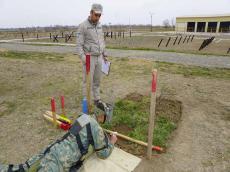
A total of 1,693.4 hectares of territory in Azerbaijan was cleared of mines and unexploded ordnance (UXOs) over the past week, the Azerbaijan National Agency for Mine Action (ANAMA) said in its weekly report, Azernews reports.
According to the agency, large-scale clearance operations were conducted across multiple regions heavily contaminated during decades of occupation. The activities covered the districts of Tartar, Aghdam, Aghdara, Lachin, Fuzuli, Shusha, Khojaly, Khankandi, Kalbajar, Khojavand, Jabrayil, Gubadli and Zangilan. Operations were also carried out in the recently liberated villages of Baghanis Ayrim, Ashagi Askipara, Kheyrimli and Gizilhajili in the Gazakh district.
During the reporting period, demining teams located and neutralised 273 anti-personnel mines, 66 anti-tank mines, and 1,511 pieces of unexploded military ordnance. These findings highlight the scale of explosive contamination and the ongoing threat posed to civilians, returning families, and reconstruction workers in the liberated territories.
Recall that large parts of Azerbaijan, particularly territories liberated after the 2020 and 2023 operations, remain heavily contaminated with landmines and unexploded ordnance (UXOs) laid by Armenian forces over the past three decades. This contamination affects cities, villages, farmland, forests, and critical infrastructure zones. Mines have caused hundreds of civilian and military casualties since the end of the 2020 war, making demining one of the country’s most urgent humanitarian and reconstruction priorities.
Besides, ANAMA has significantly expanded its operations since 2020, deploying new technologies, including drones, GIS systems, armoured machinery and working with partner states such as Türkiye, the UK, EU members, and UN agencies. Despite this, the scale of contamination is vast, and mine clearance remains a long-term challenge for Azerbaijan’s post-conflict recovery and safe resettlement efforts.
URL: http://www.today.az/news/society/263983.html
 Print version
Connect with us. Get latest news and updates.
See Also
- 30 May 2026 [15:55]
Azerbaijani Ombudsman addresses international conference on Civil Protection and Digital Rights in Italy - 30 May 2026 [15:25]
Dutch Special Envoys to visit Azerbaijan for Baku Energy Week - 30 May 2026 [13:45]
Baku weather mostly dry with mild temperatures expected tomorrow - 30 May 2026 [11:35]
Human bone remains found in Aghdara village, believed to belong to family missing since 1992 occupation - 30 May 2026 [10:27]
Azerbaijani agricultural miracle: triumph of strategy over geography - 30 May 2026 [10:05]
US official hails Azerbaijan as geostrategic partner in complex region - 29 May 2026 [12:36]
Azerbaijan awards Asaf Hajiyev with "Shohrat" Order - 29 May 2026 [10:31]
Azerbaijan facilitates another transit delivery from Russia to Armenia - 28 May 2026 [15:07]
Azerbaijani President: Independence Day is very dear to each of us - 28 May 2026 [15:00]
President: Today, every inch of Azerbaijan’s territory is under our control
Most Popular
 Russian drone hits apartments in Romania
 Romania asks NATO to speed up air defense deliveries after Russian drone strike
 Russia warns of escalation over US troops in Poland
 US embassy leaves Kyiv, Kaja Kallas says
 Ukraine says Russian drone hit Turkish-owned vessel as France summons Russian envoy
 Official reception held in Seoul to mark Azerbaijan’s Independence Day
 SOCAR deepens Italy expansion with high-level energy talks in Rome