|
|

TODAY.AZ / Politics
Pashinyan said what the revanchists feared
07 September 2026 [14:14] - TODAY.AZ

The re?education
of Armenian society cannot be compared to the educational process in the
relevant institutions for minors. It is much more difficult to re?educate a brainwashed
mass than to re?educate
young thieves and murderers who know they are committing crimes but succumb to
criminal tendencies. The brainwashed mass lives in illusions and believes in
what it does and says. When committing heinous acts in the early 1990s, this
mass in no way considered them to be crimes. The atrocities being committed were,
for her, part of that illusory world in which the church and propaganda had
placed the Armenian people. And one can only sympathize with the current
authorities of Armenia.
Nikol Pashinyan faces a very difficult task — to rid his
people of illusions. He is tackling it in a rather witty way. Like a skilled
psychotherapist.
The issue of Kyarri has stirred up Armenian society once
again in the past few days. The irritant was the statements made earlier by the
prime minister regarding this exclave of Azerbaijan. In mid?August, at a government
briefing, Pashinyan stated that, according to the maps used in the delimitation
process, Artsvashen (the village of Bashkend in the Gadabay district) belongs
to Armenia, while Kyarki, Barkhudarly and Yukhary Askipara are not Armenian
territories. This was the first time Yerevan officially confirmed the
indisputable fact — Kyarki is Azerbaijani territory.
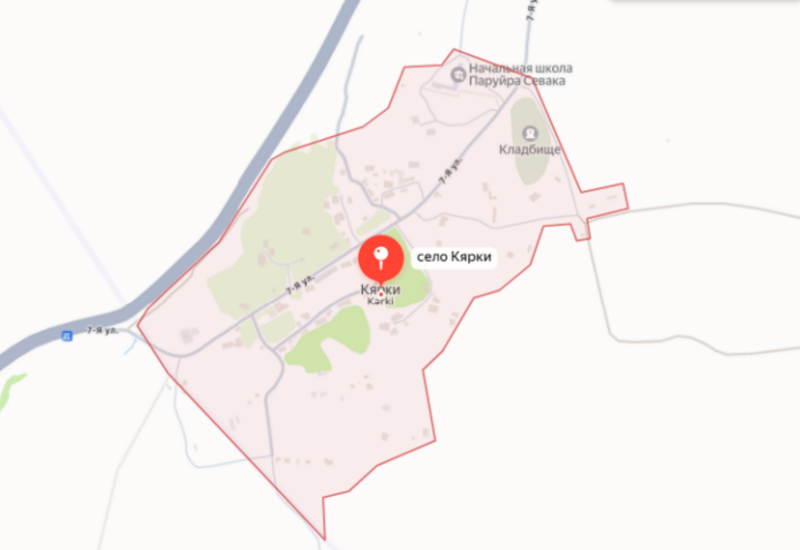
We are talking about the Nakhchivan village of Kyarki, which was occupied by Armenia in 1990 and renamed “Tigranashen”. As a result of the alienation of its territories in favor of the Armenian SSR, it ended up with the status of an enclave, and with the outbreak of the conflict, it was captured and remains under occupation to this day. Kyarki belongs to the Sadarak district of the Nakhchivan Autonomous Republic. It acquired the status of an exclave after a series of administrative and territorial “reforms” carried out in favor of Armenia in the 1920s and 1930s. Just as with the border villages of the Gazakh and Tovuz districts, by order of the central authorities, the territories around Kyarki were transferred to the Armenian SSR as part of the consolidation of (Armenian) farms and the redistribution of collective?farm lands. The lands of Kyarki, just like the lands of the Gazakh villages that were later transferred to Armenians, were allocated for pastures and arable land. These processes are recorded in the documents of that period, and there can be no questions about the ownership of Kyarki.
Having heard the correct name of the village from the prime
minister, the revanchists and other extremists went on the attack. Journalists
and opposition deputies never miss an opportunity to ask officials about the
“surrender of Tigranashen.” The day before, this question was once again put to
Nikol Pashinyan. And the prime minister responded in a way that left the
revanchist crowd bewildered: “I didn’t say anything about Tigranashen; I was
talking about Kyarki.”
The revanchist crowd is at a loss — what did the prime
minister mean to say? The head of the Security Council, Alen Simonyan,
responding to a corresponding question from journalists, batted his eyelashes:
“Who’s talking about the surrender of Tigranashen? Pashinyan simply called it
by another name.”
Let’s explain. Pashinyan’s use of the correct name for the occupied village is not a Freudian slip. It is a deliberate step. The Armenian prime minister wanted to say that there is no “Tigranashen,” but there is Kyarki. It is impossible to surrender a settlement that does not exist on the ground. If Armenian journalists do not want to use the real name of the village occupied by Armenia, they get this kind of response. Indeed, did Nikol Pashinyan mention any “Tigranashen” during the briefing in August? No, he was specifically talking about Kyarki. So, if you take everything else out of the equation, he answered completely honestly. Kyarki will be returned, but “Tigranashen” will not.
Pashinyan once again emphasized that the territory of the
Republic of Armenia is 29,743 square kilometers. The territory of the occupied
Kyarki is not included in these square kilometers. The parties agreed to
restore the borders in accordance with the Alma?Ata Declaration, and there is nothing new in the issue of
the enclaves to make people so nervous. According to the Armenian prime
minister, the main problem lies in the nervousness surrounding this issue. When
the nervousness subsides and it becomes clear that the topic cannot be
exploited, the issue will be resolved “in the best possible way.”
By “the best possible way,” Pashinyan apparently means an
exchange. That is, Azerbaijan renounces Karyaki, and Armenia renounces
Artsvashen.
It should be recalled that the village of Bashkend was
transferred to Armenia for unclear reasons in the 1930s and renamed. A hotbed
of Armenian extremism was created in yet another territory of Azerbaijan, which
made itself felt with the outbreak of the Karabakh conflict. The so?called Artsvashen had a
direct connection with Armenia and was turned into a militant staging ground.
Large gang formations were concentrated there, and they began to “clear out”
neighboring Azerbaijani villages. Thus, in 1992, the village of Mutudere was
temporarily captured. However, the occupiers soon lost the village, and as a
result of the “Bashkend operation,” the Armenian formations in Artsvashan were
also defeated, after which it once again became Bashkend.
In Yerevan, they realize that there can be no talk of any Armenian enclave in Azerbaijan. This is out of the question. They also understand that the issues related to Azerbaijan’s exclaves, including Kyarki, will have to be addressed. This is inevitable. Pashinyan does not want this to look like a concession. The situation with Kyarki is more complicated than with other occupied enclaves. The village was settled by Armenians after the occupation. It was expected that Armenia would “expand” further towards Nakhchivan, and gradually the “Tigraneshen” people stopped remembering whose lands and whose homes they were living on.
Now they have been reminded. Armenian sources claim that the
population in Kyarki is declining. Only 4 students remain at the local school,
and most of them take a specially organized bus to an Armenian village located
on the internationally recognized territory of Armenia. It is also reported
that the government’s school renovation program has bypassed Kyarki. The
governor of the Ararat region, Sedrak Tevonyan, when asked whether he also
considers “Tigranashen” to be part of Azerbaijan, evaded the question and said:
“Come and I’ll tell you on the spot.”
All these factors are very worrying to the revanchists. They
realize they cannot stop the process, but they still hope to slow it down by
carrying out appropriate work among the illegal settlers.
Recently, a “delegation” of priests visited Kyarki on a “educational visit.” As the head of the Masiatsotn diocese, Bishop Ruben Zargaryan, put it. After the group of priests was accused of political provocation and attempts to organize a revolution, the bishop with an Azerbaijani surname stated that any citizen of Armenia, supposedly, has the right to move freely and go wherever they wish. The “educational” visit was aimed at visiting some relative, but no one believes these stories. The visit to the parishioners in Kyarki was, of course, of a political nature, and the district authorities, who reported what was happening to Yerevan, were not mistaken. The priests held meetings with the residents of Kyarki, and one has to doubt that they conducted theological discussions with them.
The Church, like the revanchist opposition, hopes to pit the
population illegally residing in the occupied Azerbaijani village against the
political program of the authorities. The oppositionists themselves are afraid
to stick their heads out once again, so as not to end up in the same jail with
Karapetyan or Kocharyan.
All this fuss did not come as a surprise. And Pashinyan is
right - we need to wait it out and wait for the degree of nervousness to
decrease. Eventually, as it has been before, the neighbors will realize that a
solution to the issue is inevitable, and then passions will come to naught. How
much shouting and noise there was during the delimitation in the spring of
2024. The same thing is happening around Kärki today. As they say, this too shall
pass.
URL: http://www.today.az/news/politics/270055.html
 Print version
Connect with us. Get latest news and updates.
See Also
- 08 September 2026 [14:14]
Masochism and diaspora: how Armenian community reminds world of its crimes - 07 September 2026 [14:14]
Pashinyan said what the revanchists feared - 07 September 2026 [13:27]
Vladimir Putin makes phone call to President Ilham Aliyev - 05 September 2026 [16:13]
US Patriot shortage puts Ukraine and Europe in tough spot - 05 September 2026 [13:45]
Azerbaijan, Senegal discuss cooperation in digital development and innovation - 04 September 2026 [14:41]
What is Rubik’s team hoping for? - 04 September 2026 [14:14]
Baku has launched peace program: will Yerevan see it through to end? - 04 September 2026 [09:22]
President Ilham Aliyev congratulates Giorgia Meloni - 03 September 2026 [14:14]
Immediate threat: how Azerbaijan is dealing with “legacy” of occupation - 03 September 2026 [12:54]
Azerbaijan, Lithuania discuss regional security and bilateral ties
Most Popular
 Baku Film & Comic Con to gather film, comic and anime fans
 SOCAR to replace gas turbines with electric compressors at offshore facilities
 Azerbaijan expects nearly sixfold increase in wind power generation by year-end
 Global shipping routes hit by climate change and conflicts
 Baku hosts UN Climate Change Week ahead of COP31
 Pashinyan said what the revanchists feared
 Chovdar Necropolis ceramics in focus at EAA 2026 meeting