|
|

TODAY.AZ / Analytics
Strategic alliance with economic impact: What Azerbaijan-Israel Forum really means
27 January 2026 [14:03] - TODAY.AZ

Few bilateral relationships in today’s geopolitically fractured landscape are as quietly effective as that between Azerbaijan and Israel. Built on mutual trust, strategic alignment and pragmatic cooperation, the partnership has evolved well beyond diplomacy into a model of how political confidence can translate into economic dynamism. The recent meeting between Azerbaijan’s Minister of Economy, Mikayil Jabbarov, and Israel’s Foreign Minister, Gideon Sa’ar, followed by the Azerbaijan–Israel Business Forum, offered a timely illustration of how this relationship is entering a more mature, investment-driven phase.
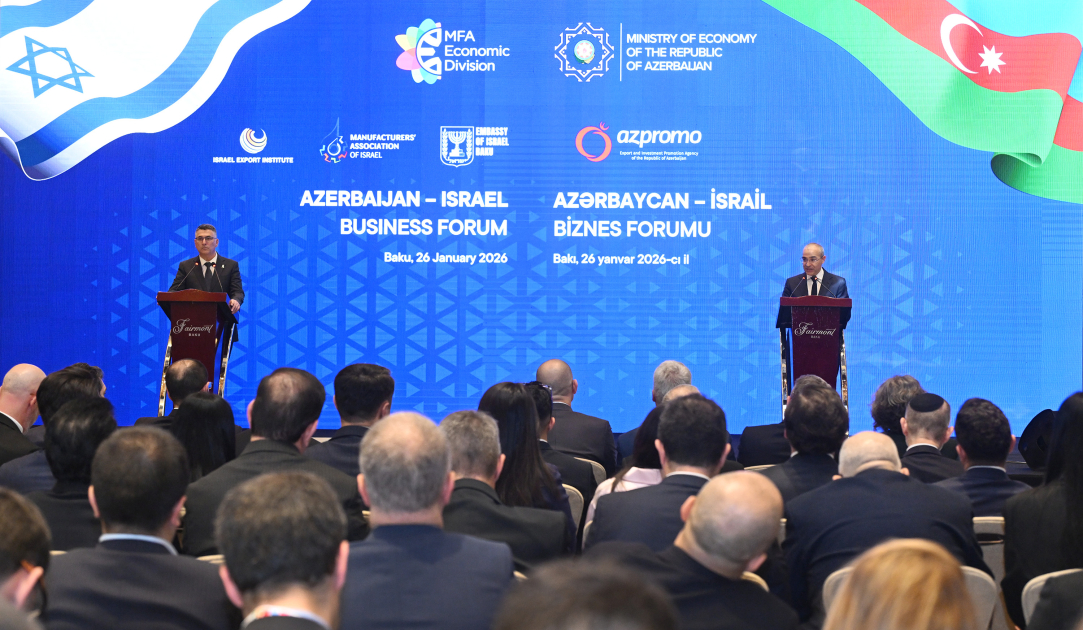
The discussions in Baku, reinforced by the presidents’ meeting on the margins of the World Economic Forum in Davos, underline a simple reality: Azerbaijan and Israel no longer view each other merely as partners of convenience, but as long-term economic allies. The Business Forum, which gathered companies and institutions across sectors ranging from agriculture and pharmaceuticals to cybersecurity, logistics and water management, was not a ceremonial exercise. It was a practical step towards deepening a partnership that is already delivering tangible results.
Looking from this perspective, Israel’s contribution to Azerbaijan’s economic modernisation is often understated. For example, Azerbaijan's oil exports to Israel to date and SOCAR's recent participation in the TAMAR project in the Eastern Mediterranean can be noted as one of Azerbaijan's important successes. Here, Azeraijan’s growing export volumes of oil in 2024 are significant. Looking through the figures for January–September 2024, it shows that Azerbaijan exported 2.37 million tons of crude oil to Israel. The value of these exports was over $1.46 billion, and this represented about 13.5 % of Azerbaijan’s total crude exports in the period. Besides, Azerbaijan’s ?nvestment in Israel’s Tamar gas field, which means also about 10 % stake in Tamar, opens new horizons for long-term revenue potential as well as giving access to the Eastern Mediterranean. Reports estimate significant returns from the Tamar stake, with around $715 million in revenue in 2024 and projections exceeding $1.2 billion for 2025–2026. So, this move shifts Azerbaijan’s energy engagement with Israel from pure commodity supply to asset ownership and joint development, laying the foundations for deeper long-term relations. In short, the Tamar stake represents a qualitative shift from selling resources to owning production shares, which can yield long-term dividends and geopolitical leverage. In simple terms, Azerbaijan expanded its oil export footprint to Israel, with Israel consistently among the key destinations for crude supply through 2024.
While energy cooperation has historically dominated headlines, Israel’s real impact lies in knowledge transfer, technology and innovation-driven sectors. Israeli expertise in high-value agriculture, advanced irrigation systems, water management and agrotechnology aligns closely with Azerbaijan’s ambition to boost productivity, sustainability and export potential in its non-oil economy.
In pharmaceuticals and healthcare, Israel’s globally competitive ecosystem, which is built on research, innovation and efficient regulation, offers Azerbaijan a blueprint for scaling domestic production, improving supply chains and reducing external dependency. As Azerbaijan works to strengthen its pharmaceutical manufacturing base and health security, Israeli know-how provides both credibility and acceleration.
Equally important is Israel’s experience in cybersecurity, fintech and high technologies. As Azerbaijan positions itself as a regional logistics, digital and financial hub connecting Europe, Central Asia, and the Middle East, cooperation with Israel adds sophistication and resilience to this ambition. Israeli firms bring not only technology, but also global networks, compliance standards and an innovation mindset that strengthens Azerbaijan’s overall investment profile.
Therefore, this cooperation is far from one-sided. For Israel, Azerbaijan represents a stable, trustworthy, strategically located and business-friendly partner in a complex region. For this reason, a brief excursion into history is sufficient to show the true reasons for the emergence of strong trust and confidence in cooperation between the two states. It can be particularly noted that Israel has a special role in expanding Azerbaijan's capabilities in the military field. After the collapse of the Soviet Union and the outbreak of the First Karabakh War, Azerbaijan faced a de facto international arms embargo. While there was no single, universal UN ban, several factors combined to restrict Baku’s access to weapons severely. For instance, OSCE-led diplomacy aimed at freezing the conflict, Russia’s dominant role as Armenia’s main arms supplier, Western reluctance to arm a newly independent state in an active conflict zone, export-control regimes and third-party component restrictions, and many such nuances were real but painful obstructions. This meant that even when countries were politically willing, arms sales often failed due to technical or legal issues. Israel’s ability to supply arms - initially modestly, later extensively - rested on three decisive advantages: export autonomy, strategic convergence and quiet, non-politicised cooperation. Generally, these experiences shaped Azerbaijan’s long-term defence and foreign-policy thinking, pushing it toward diversification over dependence, a preference for partners with full export control over their systems, scepticism toward suppliers constrained by third-party approvals, and a gradual emphasis on domestic defence production in later years. In many ways, the constraints of the 1990s explain how Azerbaijan’s later deep defence ties were formed with Israel.
Today, Azerbaijan’s diversified economy, improving legal framework and generous investment incentives - highlighted by Minister Jabbarov at the Forum - make it an attractive destination for Israeli capital seeking new markets and production bases.
Azerbaijan also offers Israel access to broader regional markets, particularly through its transport corridors, logistics infrastructure and growing role in Eurasian connectivity. Israeli companies operating in Azerbaijan are not merely investing in a single market; they are positioning themselves within a wider economic geography.
The signing of a Memorandum of Understanding between the National Confederation of Entrepreneurs (Employers) Organisations of Azerbaijan and the Manufacturers Association of Israel further institutionalises this synergy. It signals an understanding that sustained cooperation requires structured dialogue between business communities, not just government-to-government engagement.
Moreover, what sets the Azerbaijan-Israel Business Forum apart is its focus on implementation. The B2B and B2G meetings reflected a shift from conceptual cooperation to deal-making, project financing and regulatory alignment. As Israeli Foreign Minister Gideon Sa’ar rightly noted, enhancing direct contacts between business circles is essential for turning political goodwill into economic output.
The emphasis on expanding the legal framework, increasing trade turnover and accelerating joint investment projects suggests that both sides recognise the need for predictability and scale. Trust may open doors, but legal certainty and commercial logic keep them open.
The Business Forum was therefore more than an event. It was a statement of intent that Azerbaijan and Israel are ready to elevate their cooperation from successful collaboration to shared prosperity.
URL: http://www.today.az/news/analytics/265126.html
 Print version
Connect with us. Get latest news and updates.
See Also
- 09 September 2026 [14:56]
EU needs Azerbaijan more than it likes to admit - 08 September 2026 [08:30]
Azerbaijan’s wind boom opens new front in Europe’s energy market - 04 September 2026 [14:42]
SOCAR’s €600 million Nis plant takes Azerbaijan’s gas strategy into power - 04 September 2026 [08:30]
Armenia’s first export to Azerbaijan opens bigger question of peace profits - 03 September 2026 [13:58]
Can Mecca Defense Alliance reshape security from Middle East to Caucasus? - 03 September 2026 [09:00]
Washington’s Venezuela oil deal threatens China and Russia’s energy grip - 02 September 2026 [14:56]
China’s CNOOC finds more than oil in Azerbaijan’s Caspian pivot - 02 September 2026 [07:00]
Armenia wants Europe without giving up Russia’s economic lifeline - 01 September 2026 [06:00]
Azerbaijan seeks bigger role in Asia-Europe trade as SCO corridors expand - 31 August 2026 [09:47]
Why President Aliyev’s Kyrgyzstan visit matters for Eurasia’s new trade routes
Most Popular
 UK pushes back after Trump backs united Ireland
 Turkey’s Fidan to visit Syria for talks on security, trade and energy
 Over 200,000 bee colonies find new home in Azerbaijan’s liberated territories
 Putin-Zelensky meeting ruled out at G20 summit in Miami
 Iran sets seven conditions for reopening Strait of Hormuz
 At least 21 Arabs reportedly arrested in Iran's Khuzestan province
 Elite and St. Moritz to clash in Sea Breeze 2026 beach polo final