
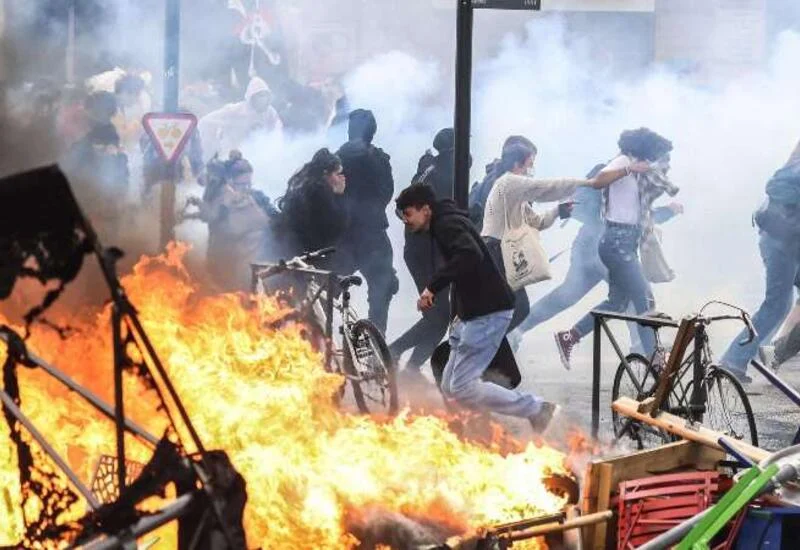
What happened last weekend in a number of French cities
shocked and frightened the authorities of this country so much that they
finally began to take action. Before that, "democratic" France had
only watched as the rebellion was gradually maturing, as passions were heating
up and forces were being concentrated in the emigrant community for a
traditional pogrom. But what about democracy?
Although it all started under the pretext of dissatisfaction with the field of education, it was clear from the very beginning that teenagers who break windows and set fire to schools are least concerned about their intellectual development. Nevertheless, the authorities did nothing to prevent the unrest from spreading, but only waved the flag of "democracy and freedom of speech." France has once again stepped on the same rake as in previous years. In this country, mass riots and pogroms have already become something like a traditional show that takes place every few years. The show always starts under plausible pretexts, and then escalates into pogroms, mass robberies and arson. Peaceful protests necessarily end in such a way that the stated reason for the actions is blurred, and only the destroyed city remains. The French authorities themselves must figure out why the peaceful protest has once again turned into an outrage. It seems that in reality they don't want to know what's going on in the country and are always waiting for it to resolve itself. They'll shout, make noise, and thrash, and they'll get over it.
Recall that it all started on September 21 with the blocking
of the Lycée Saint-Exupery in the suburbs of Paris, whose students demanded to
solve the problem of the shortage of teachers and provide schools with social
workers and psychologists. These seemingly innocent protests have disrupted the
educational process in many cities across the country. Then the students who
were having fun were joined by trade unions and members of the Yellow Vests
movement, which has extensive experience in such matters. The reasons for the
protests were supplemented by the rising cost of living and the poor state of
public services.
And what is characteristic is that France's much-loved mass
protests, peaceful and non-peaceful, have never led to a solution to one
problem or another. They won't bring you now either. There are certainly
problems in the educational sphere or with the rising cost of living in France,
but what has happened will not help solve them.
Everyone remembers the "yellow vests" movement,
which began in 2018 as a protest against pension reform and lasted for two
years. The "vests" turned from a peaceful action into pogroms and
looting and turned French cities into war zones. However, the retirement age in
France was not lowered as a result of the protests. Moreover, in March 2023,
the country adopted a new pension reform that raised the retirement age from 62
to 64 by 2030.
In fact, French democracy boils down only to the right to
protest, riots and damage to the property of citizens and the state, but not to
solving the problems that arise. And this is a system that dates back to the
time of the Great French Revolution.
According to Euronews, the footage of Saturday's violence
stunned the French. Limoges City Hall burned to the ground, as did the iconic
tourist office building on Bellecourt Square in Lyon. Vandals broke into the
city halls of Marseille, Lille, Angers and Bordeaux, where the prefect's
residence was vandalized. Paris Mayor Emmanuel Gregoire says that "entire
streets were methodically demolished." The French capital was literally
engulfed in flames. By the middle of the day, Republic Square was littered with
various shells, police clashed with rioters in a cloud of tear gas, and a thick
column of black smoke from burning fire trucks rose over the city, Euronews
writes. The robbers did not spare the Champs-Elysees, and clashes with the
police approached the centers of power - the Elysee Palace and the National
Assembly.
The morning after a terrible day and a nightmarish night,
residents of Paris, according to French media, went out to clean the streets.
The center of the capital was brought to such a state after the battles between
the police and the rioters that the utilities needed help. However, according
to another version, these dozens of people did not come to clean the streets,
but responded to a call on social networks to gather again for a protest.
The French Interior Ministry reported that police detained
2,397 people during the mass protests that took place on October 17 and were
accompanied by riots and pogroms. 997 police and gendarmerie officers were
injured during the events, seven of them were seriously injured.
The French authorities blamed the violence on radical leftist groups and participants in the pogroms. President Emmanuel Macron said on the social network X that violence has no place in the country and promised to bring the perpetrators to justice. Macron also promised to oblige the rioters to compensate for the damage caused to shops and buildings. "Those who destroyed must pay. Those who robbed must compensate for the damage," he said. In an eight-minute speech, the French president identified as the organizers of the riots "rioters from radical ultra-leftist groups, joined by numerous criminal elements." The President promised that the owners of the destroyed shops and cafes will receive compensation.
Of course, the rioters must answer for the pogroms and pay
the damages. But how are the authorities going to collect these payments from
young people from the emigrant community, who mostly have no income? Although,
judging by the celebration in the ultra-right camp, it can be said that these
forces are also involved in the riots.
The head of the far-left front, Macron's rival in the
election, Jean-Luc Melenchon, in addition to emotions, expressed a fairly
reasonable idea that the authorities had demonstrated unprofessionalism and had
done nothing to prevent riots. He pointed out, as quoted by Interfax, that
"250,000 people are called upon to ensure that no riots occur,"
referring to law enforcement forces. He accused the Interior minister of "not
noticing anything," reasonably pointing out that the Interior minister
"is capable of gathering 14,000 police officers for the Pope," while
he was able to gather only 10,000 throughout France. "What an
unprofessionalism!", Melenchon was indignant.
Perhaps those who are supposed to notice the growing threat
would have "noticed" that what happened on Saturday would not have
happened. Democracy is democracy, and the maintenance of public order, the
protection of State facilities and national wealth are among the functions of
the State. Watching what is happening in France, it seems that its authorities
have no idea what is going on in the country. More precisely, they don't want
to see it. Given the serious complication of geopolitical processes, any state
should think about how to protect itself from the coming chaos. This chaos,
which has been successfully created and maintained in other parts of the world
for many years, has now reached Europe itself, and France should get rid of the
vestige of sovereignty, remove the "insignia" and delve into solving
its internal problems. These problems and their consequences will no longer be
offset by the great past, because the world is changing, and no one's former
greatness matters anymore.
Of course, Macron cannot influence the rise in fuel prices
in the world and, as a result, in his own country. He cannot make the lives of
his citizens cheaper, because the global crisis does not allow this. It also
cannot affect climate change, although France pompously acted as a skirmisher in
this process with its Paris Agreement. But Macron could restore order, at least
in those areas that are available to him. Instead of waving the flag of
"democracy" under the noses of other countries, he should have
focused on the affairs of his native France. Then we wouldn't have to organize
a massacre with the participation of the police in order to save the city from
complete destruction.
By the way, I remembered that the day before the pogroms in
the city of Lyon, its mayor made a video speech at a conference in Yerevan and
demanded the release of Armenian criminals convicted in Baku. And he didn't
just demand it - the Lyon Mayor's office supports a certain initiative of the
Armenian diaspora to put pressure on Azerbaijan and organize an international
campaign against Baku. We think that now
he will find something to do, and for a while he will forget about his
obligations to the Armenians and remember his obligations to the French.
In theory, using the enormous law enforcement potential, the
French authorities could have prevented what happened on October 17 and
prevented a peaceful protest from turning into riots. A peaceful protest began
to turn into riots at the end of September. Even the readers of the news on the
Internet noticed this, but the French law enforcement agencies did not notice
it. The French authorities were too distracted by the internal affairs of other
states and overlooked their own problems. Now, after Saturday's massacre and
more than two thousand detainees, let's see how Paris will turn its tongue to
teach democracy to someone.
And in general, recently there have been more and more
doubts about whether the French need to pay taxes for the maintenance of a huge
army of police, if in this old democracy, the second economy of the European
Union and so on they are not able to protect what is considered not only
national, but also world heritage. A series of high-profile thefts from French
museums speaks for itself. The high-profile theft of Napoleon-era jewelry from
the Louvre is still shaking France. And in recent months, no less high-profile
thefts have been added to this. In early October, France's most expensive
210-kilogram book, The Apocalypse, with a bronze cover by Salvador Dali worth
several million euros, was stolen from a museum in Issoir. Ici Radio reports
that the museum's creator said of the incident: "France was killed last
night, the French cultural heritage was killed."
Major thefts have also occurred in recent months at the
Renoir and jewelry museums.
These are not just isolated incidents, they are evidence of
the incapacity of the mechanisms that make up the concept of the State.
Meanwhile, as Bloomberg reported on Monday, the European
currency lost 0.5% against the dollar in Asian trading on October 19. At the
same time, there was a decline in prices for French government bonds and shares
of European companies.