
The 17th Conference of the Parties (COP-17) on Biodiversity will be held in Armenia from October 19 to 30. The leaders' summit was held at the end of last week.
The very fact of holding an international event in Yerevan does not raise any questions. Other things raise questions. It is noteworthy that this event is hardly mentioned in the international media space, and moreover, no one criticizes the holding of such a conference in a country that has a lot of environmental problems, leading to problems with biodiversity. Armenia itself has a lot of problems, and Armenia creates a lot of problems for neighboring countries.
It is impossible not to recall what a hysterical international campaign has unfolded around the holding of the COP29 conference in Baku. It started almost as soon as Azerbaijan was chosen as the venue, and did not stop for a long time after the end of the event. Which, by the way, was very successful and productive. All this is in the past, but it's still hard to forget how sophisticated the Western media were in their criticism, exposing oil and gas-producing Azerbaijan as almost the main culprit of climate change. At the same time, our country accounts for 0.11 percent of emissions.
This is a very remarkable situation, which proves once again that the true essence of international campaigns is not to support international law and solve real problems.
Due to the fact that no one else wants to recall the problems of the country hosting COP17, we consider it necessary to say a few words about this. Armenia's environmental problems are her problems and she has to solve them herself. Almost all countries have such problems. We are not going to interfere in the affairs of our neighbor, but we cannot but remind you how much the ecological environment and biodiversity of Azerbaijan have suffered from his actions. It is impossible to assess what Armenia did during the conflict in the occupied territories in any other way than ecocide.
Recently, the Environmental Protection First coalition addressed representatives of civil society, states and international environmental organizations in connection with the holding of COP17 in Armenia - the 17th Conference of the Parties to the Convention on Biological Diversity.
The organization pointed out that genuine concern for nature should be free from double standards, selective approach and a feigned, insincere commitment to environmental values. In this regard, the coalition called on all COP17 participants and delegates to go beyond the standard theses and question Armenia's activities that damage the environment both inside the country and in the region through pollution of transboundary rivers. These include: chemical destruction of transboundary rivers by Armenia, environmental pollution and damage to biodiversity in the territories of Azerbaijan during the Armenian occupation, environmentally harmful industries on the borders with Azerbaijan, uncontrolled mining and non-adherence to the UN Water Convention.
In 2023, the Environmental Protection First coalition issued a statement about Armenia's transformation of the ecology of the South Caucasus into a "tragedy of public resources." The statement was made in connection with the start of construction by Armenia of a metallurgical plant in Yeraskh (Ararat region). The enterprise began to be built 800 meters from the Azerbaijani border on the banks of the Araz River. This location threatened serious problems for both the Azerbaijani territory and the transboundary river, to which Armenia had already made an "invaluable" contribution. It should be noted that due to the noise raised by Azerbaijan, the plant was moved to another location. It is unknown whether it was built or not.
If the company had started working, another hotbed of environmental tension would have been created. Over the years of the occupation of the territories of Azerbaijan, Armenia has turned them into an environmental disaster zone, and now the Azerbaijani side has to solve these problems, among other things. Some rivers originating in Armenia and flowing to Azerbaijan still remain in poor condition.
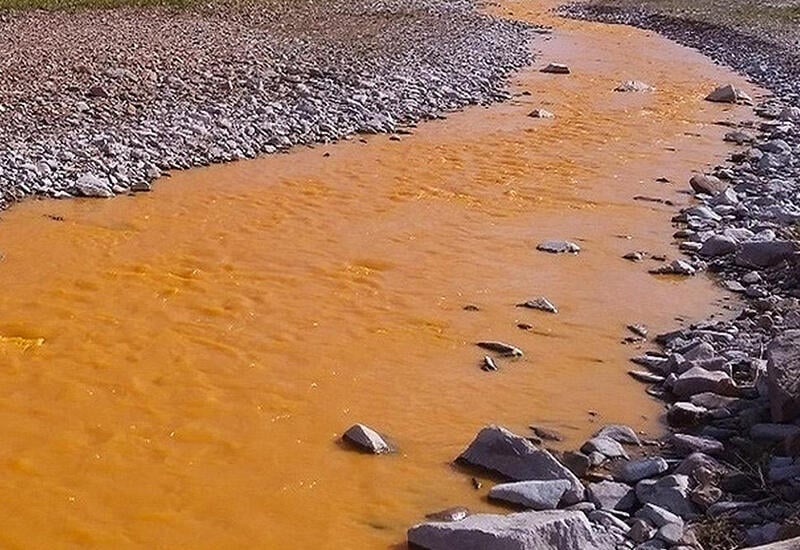
Azerbaijani experts were particularly impressed by the condition of the Okhchuchai River. Chromium, nickel, copper, molybdenum, zinc and other metal-containing waste from the Zangezur copper-molybdenum Combine and the Gafan Mining and Processing Plant, discharged into the Okhchuchai River, turned it into a chemical swamp. The river that appeared to the Azerbaijanis after the liberation of the Zangilan region was bright yellow with rusty banks. All the biodiversity in the reservoir was destroyed. The worst thing is that for several decades, the Okhchuchai, which flows into the Araz River, polluted and infected the wider water basin of the region.
Azerbaijani environmentalists once sent an open letter to Armenian Prime Minister Nikol Pashinyan, listing Armenian enterprises that pollute the environment. The letter noted that the destruction of the ecosystem as a result of ongoing mining operations at upstream mines in Armenia poses a threat not only to the environment of Armenia, but also to neighboring countries.
The transboundary water flows coming from Armenia and flowing into the Araz River have become a real collector of industrial waste from upstream enterprises. Not only Azerbaijan, but also the Iranian side has repeatedly raised this issue with Yerevan. A few years ago, there was talk of setting up a special commission to investigate the pollution of the Araz River. The issue was also raised in the Iranian parliament. The reports of experts noted that the reason for the increase in cancer among the population of the Mugan district of the Ardabil region is the pollution of the Araz River from Armenia, including radioactive waste. If this continues, it may lead to a ban on the use of river water as irrigation and drinking water, which will lead to water shortages, economic crisis and social explosion.
It should be noted that several transboundary rivers flowing from Armenia flow into the Araz.
Armenia pollutes rivers not only with human waste and wastewater, but also with metals that are dangerous to the entire ecosystem and human health. The most polluted tributaries of the Araz are the Khakaryichay and the Okhchuchay. Mining enterprises in Armenia are located on these tributaries. Unfortunately, the neighbors never bothered to take care of their own environment, and even less so were they concerned about the state of the previously occupied territories of Azerbaijan and the water problems of Iran. The waste accumulated in tailings dumps was discharged into rivers, from where the already contaminated water flowed into the Araz.
It should be noted that Armenia, unlike Azerbaijan, has not joined the Helsinki Convention on the Protection and Use of Transboundary Watercourses and International Lakes, adopted on March 17, 1992. Azerbaijan ratified the document back in 2002, while Armenia remained on the sidelines. The Armenian side knew what it was doing and feared liability for ecocide. However, it still has obligations under the Helsinki Rules of 1966 and the Berlin Rules of 2004 on the use of waters of international rivers, under the UN General Assembly resolution on transboundary waters, under the PACE resolution on transboundary water basins in Europe, and under other international documents.
For many years, Armenian environmentalists have been sounding the alarm, protesting against the operations of the mining and metallurgical industries. In 2019, the non?governmental organization Environmental Front of Armenia conducted studies and found that resuming mining at the Amulsar gold deposit would lead to the discharge of harmful substances into the Arpachay and Bazarchay rivers (Armenian: Vorotan). The Arpa flows into Nakhchivan, and the Bazarchay flows into the Araz. The Bazarchay begins in the mountains of Armenia, flows through the territory of the Kalbajar, Gubadli, and Zangilan districts, and then flows into the Araz River. During the years of Armenian occupation, this river carried harmful waste to the borders of Iran, also from the mines of Kalbajar and Zangilan that were illegally developed by Armenians.
As for the Amulsar mine, located in Jemruk, it lay idle for several years after work was suspended in 2018 due to protests. The possibility of resuming operations at the mine was discussed after the war, and in February 2025, the Armenian Cabinet of Ministers decided to provide Lydian Armenia with up to 150 million dollars in budget guarantees for the development of the Amulsar gold deposit.
Armenia has also violated other rules. Thus, there is an official expert opinion stating that it is inadmissible to build tailings dumps in landslide?prone areas; however, the tailings dump of the Tekhut mine is located precisely in such a place — in an 8?point seismic hazard zone. Furthermore, Armenian environmentalists have pointed out that instead of a proper dam, a surface dam has been built in the area, which will not be able to prevent the release of millions of tons of waste in an emergency situation.
In 2020, scientists from the National Polytechnic University of Armenia published the results of research conducted on the contamination of river water and coastal soil with heavy metals in the area near the tailings storage facility. The article, published in a scientific journal, indicates that the operation of the Tekhut copper?molybdenum enterprise in 2016 caused a ??????????? load on the environment in terms of the content of a number of heavy metals, the migration of which continued after the enterprise ceased operations in 2018. That is, even after the mine and the plant were closed, the harmful substances released into the environment continued to circulate in the atmosphere, water, and soil.
The ecological state of water bodies affects all areas. Including biodiversity.
But biodiversity suffers not only from man?made problems, but also directly from human actions.
Before the occupation, there were 260 thousand hectares of forest on the territory of Karabakh, and in thirty years this figure has decreased by almost half - by 110 thousand hectares! The furniture industry flourished in Armenia due to the forests of Azerbaijan, and meanwhile valuable tree species and other flora, 70 species of which are endemic, meaning they do not grow anywhere else on the planet, were on the verge of complete extinction as a result of logging and deliberate arson.
Back in the early 2000s, a UN mission, in accordance with the resolution “The Situation in the Occupied Territories of Azerbaijan,” conducted a ten?day assessment visit to the region and was horrified by what it saw: vast areas of scorched land, degrading soils, and a devastated ecological environment.
Armenia is also not sparing its own biodiversity. In 2023, 8,000 trees burned in the Sevan National Park, and another 10,000 were at risk of being destroyed by fire. The proximity of the region to the border means there is a risk of environmental consequences for the border areas of Azerbaijan as well.
Armenia is currently facing a water shortage problem. The extraction of groundwater for commercial fish farming and irrigation in the Ararat Valley exceeds the rate of its annual natural replenishment. The volume of water permitted to be discharged from Lake Sevan for irrigation purposes significantly exceeds historical levels of natural inflow. As a result, the risk of Lake Sevan drying up increases, which has a negative impact on its biodiversity.
By the way, about Lake Sevan. Several years ago, there was a livestock die?off on the lake shore. It was believed that the lake water might have been the cause. In recent years, the lake has repeatedly “bloomed” — the water turned green due to an increase in the amount of certain organic substances.
There are quite a few problems. But they are unlikely to be discussed at the conference in Yerevan.