
The CICA summit in Baku was remembered for its warm
atmosphere, fruitful discussions, lack of tension and recognition of
Azerbaijan's successes, which resulted in the extension of its chairmanship in
the organization for another two years.
One of the landmark events that were not included in the
summit program, but were directly related to the CICA space, was the opening of
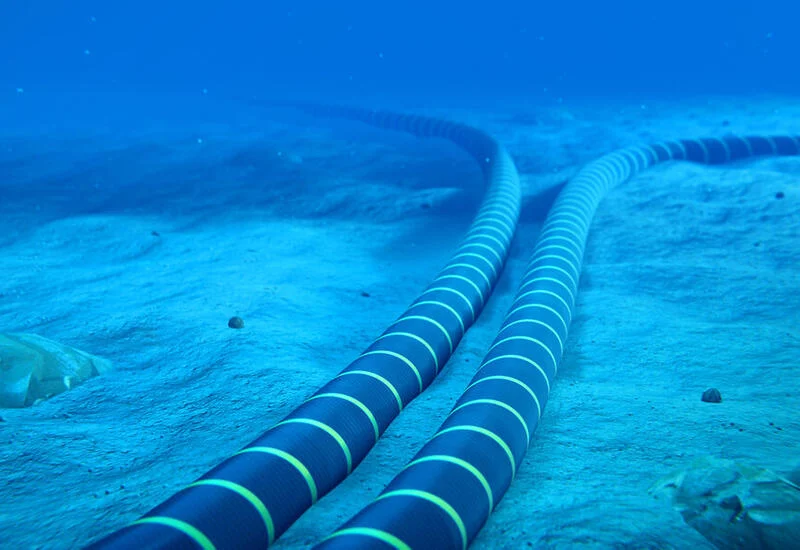
a fiber-optic cable stretching along the bottom of the Caspian Sea from the
shores of Kazakhstan to Azerbaijan.
On October 15, the Presidents of the two countries, Ilham
Aliyev and Kassym-Jomart Tokayev, officially opened the Trans-Caspian
fiber-optic communication line online.
A 380-kilometer line with a capacity of 400,400 Tbit/s has
been laid along the bottom of the Caspian Sea from Aktau, Kazakhstan, to
Sumgayit..
The new digital route will allow data to be transferred from
China and Central Asia through Kazakhstan, Azerbaijan and Georgia, and then
through the Black Sea or Turkiye to Europe. This, as it was announced at the
ceremony, will expand the possibilities of international data exchange and
increase the sustainability of digital communications. The new infrastructure
creates additional conditions for attracting investments, developing data
centers for artificial intelligence, cloud services, and computing power. It is
expected that the implementation of the project will open up prospects for the
development of new high-tech industries and services with high added value.
The President of Kazakhstan believes that this project will cause an international response. But the most important thing, he noted, is a completely new corridor and a completely new type of cooperation. The President of Azerbaijan stressed that the countries of Central Asia, the South Caucasus and a wider geographical area will be able to use the new cable line.
"Thus, today we have launched a global project,"
said Ilham Aliyev.
The project was implemented by Kazakhtelecom and AzerTelecom
companies.
It should be recalled that on March 4, 2025, with the
participation of the Prime Ministers of Azerbaijan and Kazakhstan, the heads of
AzerTelecom and Kazakhtelecom signed a document confirming the contract for the
construction of underwater fiber-optic lines along the bottom of the Caspian Sea.
The history of the project dates back to November 2019, when
Aktau hosted a solemn ceremony to start work on the Kazakh territory. In
January 2023, the parties detailed the terms of cooperation, and in June of the
same year they signed a joint-stock agreement to establish the company
CaspiLink B.V, a joint venture that will take over the construction and
subsequent operation of the line. Last year, careful studies of the seabed and
the search for the optimal route were carried out. The actual laying of the
cable itself began in July this year from Sumgayit.
It should be noted that the specialized armored fiber-optic
cable for the strategic project of the Trans-Caspian digital highway was fully
manufactured and tested in China. The Chinese technology company HMN
Technologies (formerly Huawei Marine) was engaged in the development and
production of the underwater cable system. The cable is a deep-sea armored
optical communication line with built-in optical amplifiers of the ROPA type.
The cable manufactured in China, along with auxiliary equipment, was delivered
to the Kazakh port of Kuryk, after which it was transported to Baku for loading
onto a cable laying vessel.
The Trans-Caspian fiber optic cable can be considered a
digital segment of the Middle Corridor. This cable line is an important part of
the Digital Silk Way project, a megaproject to create a digital
telecommunications corridor that will run through the territories of various
countries, including Azerbaijan, Georgia, Turkiye, Kazakhstan and Turkmenistan.
The Digital Silk Road project attracted international
interest at the Dubai Expo and the global Capacity Middle East 2022 event. The
event "Digital Silk Road - Communication without Borders", held in
the pavilion of Azerbaijan at the Dubai Expo, highlighted the areas of
cooperation, bringing together representatives of many influential
international companies. And during the Capacity Middle East 2022 in Dubai,
companies such as Google, Cienna, Lumen, Neterra, China Telecom Global, China
Mobile International, Vodafone Carrier Services, Turkcell Superonline, Vodafone
Turkiye, Batelco, STC and others showed great interest in the project.
The project was recognized as one of the top five strategic
infrastructure projects in Asia at the Global Strategic Infrastructure
Leadership Forum in the United States.
This line may be needed not only by countries that are
traditionally referred to as transit route addresses.
In August, a data processing center and an AI factory opened
in Hrazdan, Armenia. At the opening, representatives of the leadership of the
American Firebird said that Armenia will not be the only market and certain
plans are being made for Kazakhstan. After that, the Armenian expert community
started talking about the possibility of using facilities in Armenia and
Kazakhstan to connect the Caspian cable running through Azerbaijan. In fact,
the Armenian side has no other options. Data centers and AI factories are being
set up on different sides of the Caspian Sea, which means that they simply cannot
have other options for data exchange, if necessary. Any communications,
especially of American origin, from Armenia to Central Asia can only pass
through Azerbaijan.