Today.Az » Politics » All roads lead to Azerbaijan: fantasies and realities of the Armenia-EU format
06 May 2026 [13:13] - Today.Az
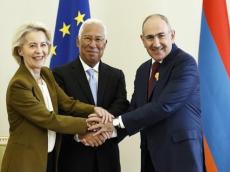
European Commission President Ursula von der Leyen, European
Council President Antonio Costa and Armenian Prime Minister Nikol Pashinyan
attended the signing of the EU-Armenia Partnership Agreement in the field of
transport infrastructure. The document was signed during the European Political
Partnership summit in Yerevan.
Let's say right away: We are not at all against Armenia's
partnership with the EU in the transport sector, but we are in favor of the EU
spending money on realistic tasks that will not remain on paper, but in
practice will benefit both the Armenian side and the region. One can talk as
much as one likes about the integration of Armenia's transport networks into
the European logistics system, but in reality nothing will change from these conversations.
How Armenia's transport networks can be integrated into the
European logistics system. Yes, it sounds beautiful, but what's in this phrase
besides pleasing the ear? Basically, nothing. In order for Armenia to connect
to European transport networks, it is necessary to create an infrastructure
that this country has never had. These are thousands of kilometers of railways
and highways, billions of euros. Somehow, the European Union does not look like
a party eager to help Yerevan with all this.
For those who object that the EU undertook to finance the
Nakhchivan highway, let's explain: It's only about partial financing, but
Azerbaijan does the rest on its own. In the case of Armenia, we have a very sad
picture. And very controversial. The scale of today's freight transportation
cannot do without the railway. And there is no hardware suitable for these
purposes in Armenia. Even if you really want to, the existing lines will not be
able to provide international transit of goods. They are generally unsuitable
for heavy trains, no matter how much you upgrade them. For example, on one of
their sections in the direction of the Gaaakh region, the line runs through a
dangerous landslide zone. A few years ago, there was a landslide and the road
was not restored after that as it could not be restored. Yerevan is currently
raising the issue of repairing this section to Russian concessionaires in the
hope of using this area before TRIPP is implemented. But the SCR is in no
hurry.
Maybe the EU wants to take on this pointless task? And how
do Costa and Von der Leyen propose to combine all this with the European
network?
Let's have the nerve and try to give some advice.
The advice is not new, it will soon be six years old. We are
talking about the Zangezur corridor, which has been defamed in Europe for all
these years, called a threat to Armenian sovereignty, and this important idea
for Armenia has been discredited in every possible way. Instead of the Zangezur
corridor, EU officials seized on the unrealizable "Crossroads of the
World", constantly pushing it into all joint statements with Yerevan.
How can one not recall President Ilham Aliyev's subtle
teasing in response to a question from an Armenian journalist at the last
Munich Conference? "As for your so-called "Crossroads of the
World," you know, when President Trump returned to power, he launched
TRIPP. When President Biden returns, he will restart your Crossroads of the
World," said Ilham Aliyev.
Very subtly and sarcastically, it was simply impossible to answer
the provocateur's question better.
We do not know if the "Crossroads of the World" is
mentioned in the agreement signed in Yerevan the day before. It would be better
for Armenia if he wasn't there. If all the projects are based on this
idealistic idea of Nikol Pashinyan, then nothing will work. The only way to
productively integrate Armenia into international transit is the Zangezur
Corridor, now called TRIPP. This is the only route that can provide large-scale
and efficient logistics. And most importantly, the EU doesn't have to do much
here. All we need to do is financially support the restoration of the
Nakhchivan railway. All other projects can be left for later and frolic with
their implementation when the country has already become a real transit
country.
Other areas, as we have already said, are not suitable for
the scale of today's logistics. Even if you have money, because you can't go
against nature. The mountainous terrain won't allow it. Why spend billions on
tunneling through mountains and building bridges over chasms when there is
already a reliable way to solve the problem?
Once again, Azerbaijan is not at all against the development
of Armenian transit and Yerevan's cooperation with the EU for this purpose. We
are simply amazed at the pleasure with which precious time is being spent,
which is needed by the region, for which the peace agenda has opened up great
opportunities. If the EU had supported the Azerbaijani project at the time,
instead of trampling it in every resolution, Armenia could now enjoy the fruits
of its geography. In the new geopolitical situation, the South Caucasus has
become the "road of life" for East and West, as well as for North and
South. But it took six years of demagoguery.
Certain agreements were also reached in Yerevan in the
energy sector.
European Commission President Ursula von der Leyen said at
the opening of the Armenia-EU summit in Yerevan that the European Union is
ready to invest in the development of Armenia's energy sector and expand energy
ties across the Black Sea, as well as support the country's infrastructure
projects. The European Global Gateway initiative has already provided 2.5
billion euros of investments in this country.
At the meetings held by Nikol Pashinyan in Spain three years
ago, he was promised the support of the European Commission for Armenia's
participation in regional projects such as the Black Sea underwater electric
cable.
On December 17, 2022, Azerbaijan, Georgia, Romania and
Hungary signed a strategic partnership agreement in Bucharest, which provides
for the construction of an energy bridge from the Caucasus region to Europe. In
the future, Central Asia showed interest in the transit of its energy to
Europe, in connection with which the construction of the Trans-Caspian energy
cable began.
The Black Sea Energy project is an integral part of the
energy agreements between the EU represented by the European Commission and the
Republic of Azerbaijan, as well as a flagship project for Georgia as part of
the EU Global Gateway project. The project has received full support from the
European Union and major financial institutions. I remember that after signing
the agreement in Bucharest, Armenian experts bitterly stated that Armenia had
completely dropped out of regional competition in the field of electric power.
In what capacity and with what forces can Armenia participate
in this project? It can join as an exporter through the Georgian electric grid.
But here's the problem - the construction of the Armenia-Georgia transmission
line has not started for many years. Armenian experts fear that it will never
be built at this rate. The existing old energy infrastructure of the country is
not suitable for energy supplies of the expected volumes. But there was a time
when Armenia planned to turn into a regional electric power hub. In 2016, a
roadmap was signed for the creation of a North-South energy corridor between
Armenia, Georgia, Russia and Iran. Since then, things have not moved a single
centimeter, but the Iran-Azerbaijan-Russia energy bridge has started working.
And Armenia still cannot complete the construction of a power line towards
Iran.
European Union High Commissioner for Enlargement Marta Kos
said earlier that the EU will invest 500 million euros in strengthening energy
security and diversifying Armenia's energy supply. These funds will be used to
connect the Armenian energy system with the Georgian one. According to Kos,
work is underway on the Armenia-Turkey energy system within the framework of
the Caucasian Power Transmission Network, so that you are less dependent on
Russian energy.
By the way, the agreement on Armenia's accession to the
Caucasian Power Transmission Network was signed back in 2015, and the current
EU leadership promises the same to the current Armenian leadership. What has
been done in 11 years is not reported.
It is much easier to solve problems with electricity than
with other media. Earlier, there were calls from European cabinets to abandon
Russian gas and promises to ensure Armenian energy security. How? No one knows
that. The EU has been promising Armenians to ensure Armenia's energy security
since the time of the Karabakh clan.
To draw Armenia into its orbit, a couple of years ago,
Brussels promised Armenia to ensure its energy security through supplies. And
then most of them made round eyes and thought, "but how?" Indeed, but
in what way?
First of all, Europe is itself an importer of fossil fuels,
and it needs them. Recent geopolitical developments have further exacerbated
the problem. It became clear to everyone that the course towards global
decarbonization and a massive transition to renewable energy sources would have
to be postponed until better times. Even with soaring oil and gas prices, it is
impossible to abandon these resources.
Secondly, even if we assume boundless altruism, which will
force the EU to share the latter in order to separate Armenia from Russia and
re-export fuel to this country, it is not difficult to imagine how much this
"charity" will cost Armenian households.
And finally, the most important thing. There is no
infrastructure that would allow the transportation of oil and gas to Armenia
from European countries. She never physically existed. No, if the EU is ready
to build a pipeline, that's another matter...
It is not serious to consider any other options when Armenia
is neighboring a country that produces oil and gas. Azerbaijani oil products
are already being shipped to Armenia. Why doesn't the EU offer Yerevan to
finance a pipeline to the borders with Azerbaijan? More precisely, to restore
the gas pipelines that existed in Soviet times for the supply of Azerbaijani
fuel to Armenia. And at the same time, finance the restoration of Azerbaijani
lines towards Armenia, which have been inactive since the early 90s? This would
allow the Armenian side to resolve the issue of diversification and energy
security much faster than signing even a dozen agreements with the EU.
As we can see, no matter how the problems of Armenia and
their solutions are twisted, in the end they still lead to Azerbaijan. The EU
is a rather vague political course for Armenia, and its closest neighbor is a
reality. Therefore, it must be clearly understood that transit opportunities,
energy security, and integration into international projects are unrealistic
for Armenia without Azerbaijan. Azerbaijan is not an improvised tool, not an
addition to the project, not a traveling companion, not a passive observer.
He's the main player.
|
